
What Mattress to Stay Away From and Why It Fails You
Last Updated: November 5, 2026
Quick Summary
What mattress to stay away from? Skip any bed that hides its materials, skips certification, or promises too much for too little. Also avoid mattresses with low-quality foam, no trial or return policy, and a warranty under 10 years.
- Check the law tag and spec sheet, since the law tag does not list foam density.
- Ask for coil count and coil gauge, because thinner wire bends more easily.
- Get fiberglass disclosure in writing, including its location and cover-care rules.
- Ask for certification names and certificate numbers you can verify independently.
- Request the full warranty document and return policy in writing before you pay.
Table of Contents
- Warning Signs of a Mattress to Avoid
- Mattresses to Avoid for Back Pain
- Memory Foam Mattress Safety: Fiberglass and Chemical Concerns
- How to Verify Materials and Certifications Before You Buy
- Durability, Lifespan, and the Complaints That Reveal a Bad Mattress
- Shopping for a Mattress to Avoid at Mattress Outlet of Chattanooga
- Frequently Asked Questions
Warning Signs of a Mattress to Avoid
Wondering what mattress to stay away from? Start with one rule: skip any bed that hides its materials, skips certification, or promises too much for too little.
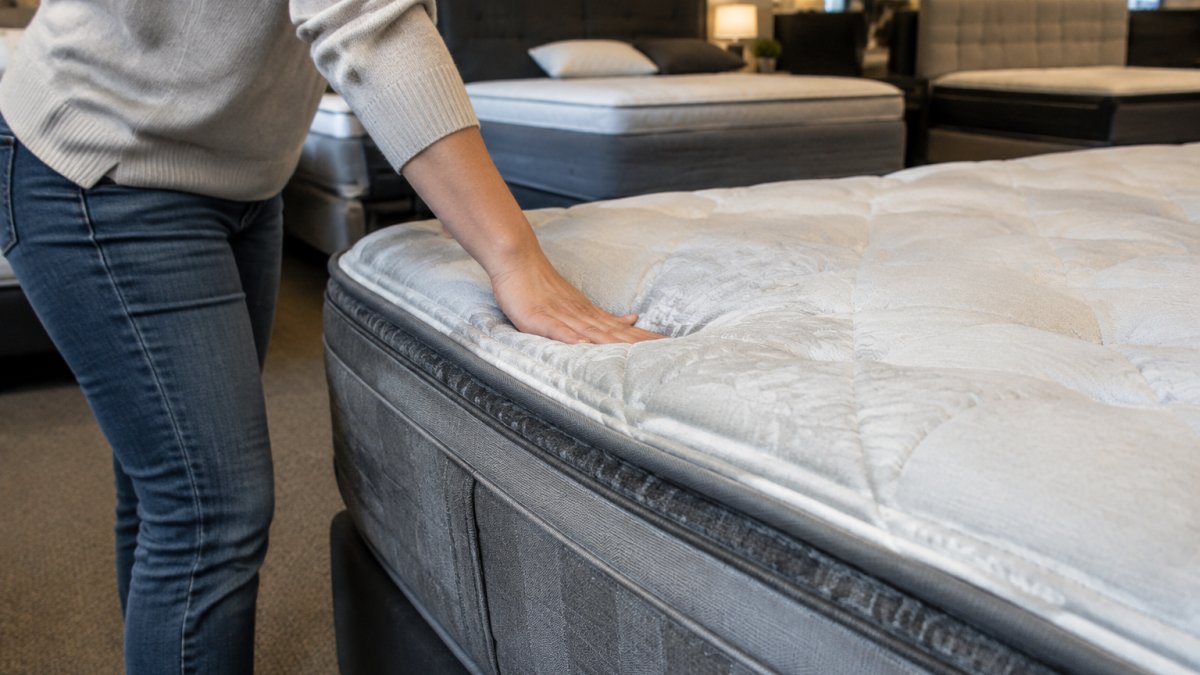
A mattress is a layered sleep surface built from foam, coils, or both, wrapped in a cover and sold with a warranty.
Here’s what we tell every customer to check before they buy:
- No material list on the label or website. If you can’t see what’s inside, walk away.
- A price that seems impossibly low for the size and thickness.
- No trial period and no clear return policy.
- Vague firmness claims with no support details.
- A warranty under 10 years on a bed sold as long-lasting.
Below, we break down each warning sign, the materials that fail first, and how to verify a mattress before you pay.
Low-Quality Foam and Cheap Materials
The fastest way to spot a bad mattress is to look at its foam. Low-quality foam, usually cheap polyurethane foam, breaks down quickly. It softens, compresses, and stops supporting your body. A common mistake is judging a bed by how it feels in the first five minutes. The real test is how that foam behaves after a year of nightly use.
Watch for these material red flags:
- Very low-density foam in the comfort layers, which packs down fast.
- Synthetic latex passed off as natural latex.
- No mention of organic materials or certifications anywhere.
- Strong chemical smell right out of the wrapper.
If you’re weighing whether a bargain bed is ever worth it, our guide to cheap mattresses and whether they’re worth it breaks down when low prices are a deal and when they’re a warning.
Construction Red Flags and Coil Count Claims
Construction tells you how a mattress will age. In an innerspring or hybrid mattress, coil count and coil gauge matter, but a big number alone doesn’t mean quality. Some brands rely on coil count alone, which can hide thin wire that loses shape. Others hide weak edge support behind a plush cover.
Check these construction points:
- Coil gauge: thinner wire bends sooner. Ask for the gauge, not just the count.
- Edge support: press the corners. Weak edges mean a smaller usable sleep surface.
- Layer order: supportive foam belongs below, soft foam above.
- Motion isolation: if you share a bed, test how much movement travels across the surface.
A high coil count on a poorly built bed is marketing, not quality.
Before you shop, here are the red flags we tell every customer to check.
|
Warning sign |
What to look for |
|---|---|
|
Hidden materials |
No material list on the label or website |
|
Impossibly low price |
Price too low for the size and thickness |
|
No trial or return policy |
No trial period and no clear return policy |
|
Vague firmness claims |
Firmness claims with no support details |
|
Short warranty |
Warranty under 10 years on a bed sold as long-lasting |
|
Low-quality foam |
Very low-density foam in the comfort layers |
|
Fake latex |
Synthetic latex passed off as natural latex |
|
Chemical smell |
Strong chemical smell right out of the wrapper |
Mattresses to Avoid for Back Pain
For back pain, avoid mattresses that are too soft or too firm, and skip any bed with worn or uneven support. Both extremes strain the spine. A mattress that’s too soft lets your hips sink and your lower back curve.
These are the mattresses to avoid for back pain:
- Old, sagging beds with visible body impressions.
- Ultra-plush foam beds with no support core.
- Rock-hard budget innersprings with thin padding.
- Any bed you can’t test for firmness before buying.
Support and pressure relief should work together. Side sleepers usually need more cushioning at the shoulder and hip. Back and stomach sleepers need a firmer surface to keep the spine neutral. If you’re waking up sore, our guidance on avoiding back pain while sleeping covers sleep position and setup fixes that help.
Memory Foam Mattress Safety: Fiberglass and Chemical Concerns
Memory foam mattress safety comes down to two things: fiberglass and chemical compounds. Some low-cost foam mattresses use a fiberglass barrier as a flame retardant instead of a fiber sock. If the cover tears, those fibers can escape into a room and irritate skin, eyes, and lungs.
Chemical concerns matter too. New foam can off-gas, and some cheap beds use materials with little disclosure. Here’s how to lower the risk:
- Ask whether the mattress contains fiberglass. Get it in writing.
- Check for certification of foam and fabric safety.
- Look for a removable, washable cover that stays intact.
- Air out a new foam bed in a ventilated room before sleeping on it.
If a seller won’t answer a fiberglass question directly, treat that as your answer.
How to Verify Materials and Certifications Before You Buy
You can verify a mattress in about ten minutes with the right questions, but the answers only help if you know what the numbers mean. Independent testing and certification separate real quality from marketing claims, and the strongest approach is to evaluate the specific model rather than the brand. Quality varies within a single manufacturer: a company’s flagship line may use dense, certified foam while its entry-level line uses low-density polyurethane and no third-party testing. Always ask for the model name and construction details, not just the brand.
Start with the law tag and the spec sheet. The law tag lists fiber content and country of origin, but it does not list foam density.
For coils, ask for both coil count and coil gauge. Coil gauge is the wire thickness: a lower gauge number means thicker wire.
Call Us Today (423) 255-8124 → →
Certifications are where sellers often get vague. Ask for the exact certification name and what it covers. Third-party certification programs exist for foam content, emissions, and textile safety.
Fiberglass disclosure deserves its own written answer.
Use this verification checklist for the exact model you are considering:
- Model name and construction details (foam types, densities in lb/ft³, coil gauge and count)
- Foam density numbers in writing, not just “high-density” marketing language
- Coil gauge and coil unit type, plus edge-support construction
- Fiberglass disclosure in writing, including location and cover-care rules
- Certification names and certificate numbers you can verify independently
- Warranty terms in full, including impression-depth exclusions
- Trial period length, return window, fees, and pickup requirements
- Firmness rating and support details tied to your sleep position and body weight
A brand that answers all eight clearly for a specific model is worth your time. One that dodges even two answers the question of what mattress to stay away from. For broader context on what sellers must disclose on labels, the Federal Trade Commission’s guidance on mattress labels explains the required fiber-content and origin information. Federal Trade Commission mattress labeling guidance
Durability, Lifespan, and the Complaints That Reveal a Bad Mattress
Durability separates a value mattress from a cheap one. A well-built bed should hold its shape for years. A poor one sags early, develops body impressions, and loses edge support. Customer reviews and complaints reveal these patterns fast, if you know what to search.
Look for these complaint patterns:
- Sagging within the first year in the same spot.
- Body impressions that don’t recover.
- Weak edge support that pushes you toward the middle.
- Sleeping hot despite cooling technology claims.
- Warranty claims denied over minor issues.
To judge lifespan, our breakdown of how often to replace your mattress gives clear timing. If longevity is your priority, compare mattress brands known for longevity before you shop.
Shopping for a Mattress to Avoid at Mattress Outlet of Chattanooga
The best defense against a bad mattress is a store that shows you exactly what you’re buying. Mattress Outlet of Chattanooga sells brand-new mattresses. Ask us directly about materials, construction, and terms before you buy.
Here’s how we help you avoid the traps:
- **- Brand-new mattresses, not refurbished or returned stock.
- Flexible payment plans and layaway for budget-conscious families.
- A personalized shopping experience.
- Same-day pickup so you’re not stuck waiting.
Ready to skip the red flags and see real options? Browse our mattresses to compare sizes, firmness, and materials in person.
Frequently Asked Questions
What mattress brands should I stay away from?
There is no single brand list that applies to everyone. Instead, judge the specific model: check for low-density polyurethane foam, vague coil-count claims, no fiberglass disclosure, and a warranty that prorates quickly. A brand with good models can still sell a poor-performing entry-level line. Ask for the spec sheet and compare materials model by model before you decide.
Are memory foam mattresses toxic to sleep on?
Most memory foam sold today uses polyurethane foam that off-gasses volatile organic compounds when new, which is why a new mattress can smell for a few days. The bigger safety risk is fiberglass: some budget foam mattresses use a fiberglass barrier instead of a proper fire sock, and the fibers can escape through the cover. Look for a fiberglass-free disclosure and a third-party certification on the foam.
What mattress should I avoid if I have back pain?
Skip mattresses that are too soft and let your hips sink out of line, and skip ultra-firm models that create pressure points at the shoulders and hips. Both push your spine out of neutral. For back pain, look for a medium-firm mattress with real support layers and a trial period long enough to test it, and avoid any mattress with a short or heavily prorated return policy.
How can I tell if a mattress is made with safe materials?
Ask for the foam density and the fiberglass disclosure in writing, and check for third-party certification on the foam and a fiberglass-free statement on the cover. Read the law tag on the mattress itself. If a seller cannot answer what the fire barrier is made of, treat that as a red flag and keep looking.
Avoiding a bad mattress is simpler than it looks: check the materials, verify the certifications, and read the fine print. Mattress Outlet of Chattanooga makes that easy with brand-new beds, honest answers, and flexible payment plans and layaway. Get started with Mattress Outlet of Chattanooga and sleep on a bed you can trust. Call us today at (423) 255-8124.


