
How Long Do Hybrid Mattresses Last? A 2026 Guide
Table of Contents
- How Long Do Hybrid Mattresses Last? The Real Answer
- Signs You Need a New Mattress
- How Often to Replace a Mattress: A Practical Timeline
- How to Make a Mattress Last Longer
- How Often to Rotate a Hybrid Mattress
- Warranty Coverage vs. Expected Usable Life
- Conclusion
- Frequently Asked Questions
Last Updated: October 10, 2026
How Long Do Hybrid Mattresses Last? The Real Answer
Most hybrid mattresses last 6 to 10 years, with seven to eight typical for a mid-quality model. Higher-end hybrids with denser foams and thicker coils often reach 10 to 12 years; budget hybrids wear out closer to six.
The range is wide because how long hybrid mattresses last depends more on what’s inside them and how you treat them than on the label.
A hybrid doesn’t die on a schedule, it dies when its support gives out.
Below: why estimates vary, how to inspect your mattress in ten minutes, and what extends its life.
What “End of Life” Actually Means
The second reason estimates diverge: nobody agrees on when a mattress is dead.
Three definitions are in play:
- Structural failure. A coil breaks, a foam layer crushes permanently, or edge support collapses. Objective, and often covered by warranty.
- Functional failure. The mattress holds together but no longer keeps your spine aligned or relieves pressure. This drives most replacements, and it’s subjective.
- Preference change. The mattress is fine, but you want something firmer, cooler, or bigger. Survey data counts this as a replacement even though nothing failed.
A durability lab measuring structural failure might rate a mattress at 10 years; the owner might hit functional failure at year seven. Both are correct answers to different questions.
The Variables That Actually Move the Number
Strip out the measurement noise and a handful of physical factors drive the real timeline:
- Foam density. Measured in pounds per cubic foot. Lower-density foams compress and lose rebound faster; a denser comfort layer resists body impressions longer, which is the biggest reason premium hybrids outlast budget ones.
- Coil gauge and count. Thinner wire fatigues sooner; a higher coil count spreads load across more contact points.
- Sleeper weight and concentration. A 240-pound sleeper who stays in one position stresses the foam far more than a 140-pound sleeper who moves around.
- Foundation type. A weak or flexing base lets the mattress bend where it wasn’t engineered to, accelerating foam breakdown and coil fatigue.
- Rotation habits. Rotating spreads compression instead of letting it concentrate in one zone.
So when you read “hybrid mattresses last 8 years,” that’s a blended midpoint built from mixed measurement methods. Your mattress may beat it or miss it, and now you know which factors decide which.
Signs You Need a New Mattress
The clearest sign you need a new mattress is a visible sag or dip where you sleep that doesn’t bounce back within a few minutes of getting up.
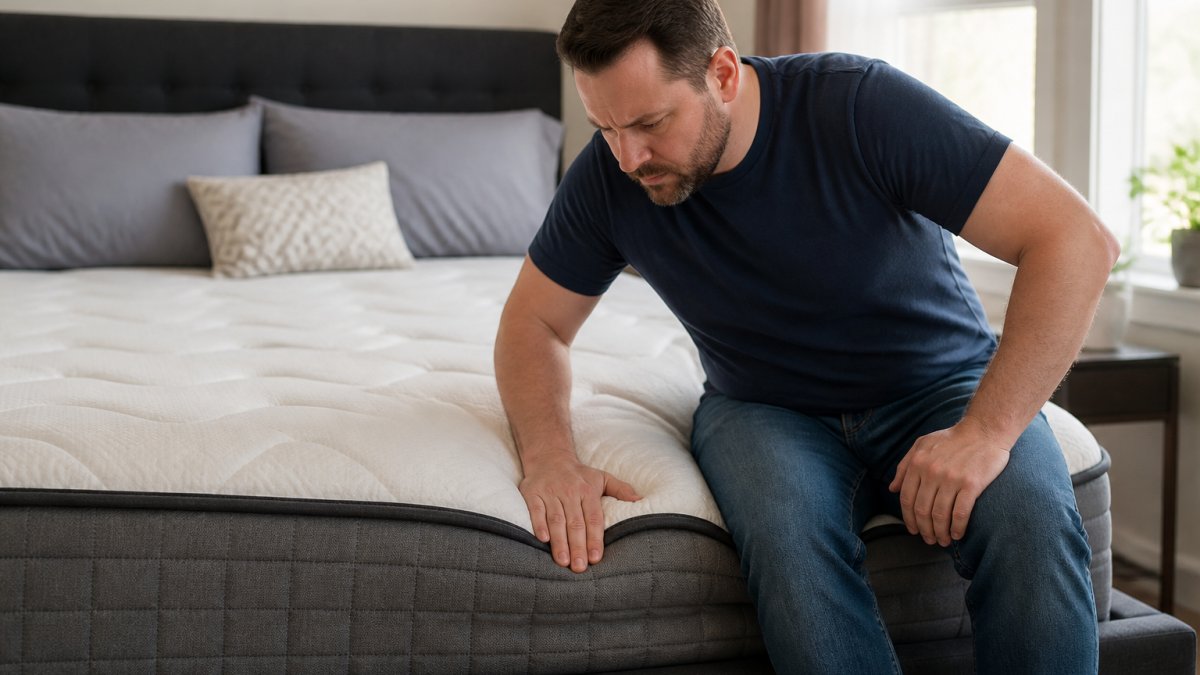
But “it feels worn out” is not a diagnosis. Before you spend money, run this ten-minute inspection, no tools beyond a straightedge and tape measure, to separate normal settling from genuine failure.
The Ten-Minute Mattress Inspection
Step 1: Strip the bed and look from directly above. Stand at the foot of the bed and sight down the surface.
Rule of thumb: impressions under about three-quarters of an inch are normal settling.
Step 3: Test the edges. Sit on each corner and along each side, then stand up. The edge should push back and recover.
Step 5: Listen and feel for coil problems. Press down and release slowly.
Step 6: Lie down in your normal position for ten minutes. This functional test matters most.
Normal Settling vs. a Replacement-Level Problem
Every mattress settles. The question is whether you’re feeling expected break-in or actual failure:
- Normal settling: shallow impressions under about three-quarters of an inch, even softening, foam that recovers within minutes, no change in how your body feels in the morning.
- Replacement-level problem: impressions deeper than roughly an inch, a dip concentrated in one zone, foam that stays compressed, coils you can feel, new noise, or waking up sore in the same spots most mornings.
The pattern matters as much as the depth. A mattress that softened evenly is usually still supportive; one with a deep crater where you sleep has failed locally, and that’s the failure that ruins sleep.
The Symptoms That Point to Replacement
If the inspection turns up any of these, it’s time to shop:
- You wake up stiff or sore in the same spots most mornings
- You roll toward the middle or edge of the bed without trying
- The mattress feels noticeably softer in your usual sleep position than elsewhere
- You can feel the coils through the comfort layer
- The mattress makes new creaking or popping sounds
- The dip exceeds the sag threshold in your warranty, which means you may have a claim
Sagging and Body Impressions
A body impression is a shallow dip that forms where you sleep most nights. Every mattress develops some over time. The question is depth, and depth is measurable.
If the dip is deeper than about one inch with no one on the bed, the comfort layer has broken down, usually the point where pressure relief stops working and you start waking up sore. Measure with a straightedge rather than eyeballing it; a dip that looks alarming from above often measures smaller than it appears.
Loss of Support and Pressure Relief
Loss of support is different from sagging. The mattress may look flat but still feel like it’s pushing back unevenly.
Test it by lying on your back for ten minutes. If your hips sink lower than your shoulders, spinal alignment is off, a support problem, not a comfort problem, and it won’t fix itself. On your side, your spine should stay roughly straight; if your waist sags toward the mattress, the support core has softened under your midsection.
How Often to Replace a Mattress: A Practical Timeline
A practical replacement timeline for a hybrid mattress is every 7 to 8 years for average use. Adjust up or down based on the factors below.
|
Situation |
Expected Lifespan |
Why |
|---|---|---|
|
Single sleeper, average weight, quality hybrid |
8-10 years |
Less concentrated wear |
|
Couple, average weight, quality hybrid |
7-8 years |
Two wear zones instead of one |
|
Sleeper over 230 lbs |
5-7 years |
More stress on foam and coils |
|
Budget hybrid, nightly use |
5-6 years |
Lower-density foams break down sooner |
|
Guest room, occasional use |
10+ years |
Far fewer compression cycles |
These are estimates, not rules. A well-built hybrid used gently can outlast a cheap one used hard.
How to Make a Mattress Last Longer
The single biggest thing you can do to make a mattress last longer is support it properly from underneath. A mattress performs only as well as the foundation beneath it.
Sleep Foundation guidance on mattress care and foundations
Beyond that:
- Use a waterproof, breathable mattress protector and wash it monthly
- Rotate the mattress on schedule (more on that below)
- Avoid sitting on the same edge every night
- Keep pets off if you can, or use a thick protector if you can’t
- Let the mattress air out after removing bedding
Foundation and Bed Frame Matter More Than You Think
A hybrid needs a firm, flat, well-supported base. A slatted frame with wide gaps lets the mattress sag between slats; a weak box spring adds bounce the coils weren’t designed for.
What most guides miss: the wrong foundation can void a warranty. Many manufacturers require a specific base type, so check the warranty terms before you buy if you’re unsure yours qualifies.
How Often to Rotate a Hybrid Mattress
Rotate a hybrid mattress every three to six months for the first year, then every six months after that. Rotation spreads wear and delays body impressions.
Most hybrids today are one-sided, so rotate them head-to-foot rather than flipping. Never flip a mattress not designed to be flipped.
Set a phone reminder every three months. It takes two people about a minute.
Consumer Product Safety Commission guidance on mattress safety and care
Warranty Coverage vs. Expected Usable Life
A mattress warranty and a mattress lifespan are not the same thing, the gap that trips up most buyers.
A warranty covers defects: a broken coil, a split seam, a foam layer that collapses prematurely.
So your mattress may be “used up” long before the warranty expires, or fail in year three in a way the warranty does cover.
Read the fine print on two things:
- The sag threshold. Many warranties only kick in past a certain dip depth, often measured with a straightedge.
- The foundation requirement. Using the wrong base is one of the most common reasons claims get denied.
If you’re replacing a mattress that failed early, ask why before you buy again. The cause is often the base, not the mattress.
Conclusion
Figuring out when to replace a hybrid mattress comes down to one question: does it still support your body the way it did in year one? If not, the label’s estimated lifespan doesn’t matter.
At Mattress Outlet of Chattanooga, we help local sleepers replace worn-out mattresses without paying retail prices. We offer brand-new mattresses at 60-80% below retail through truckload pricing, quality furniture from Ashley Furniture Direct, and flexible payment plans and layaway. We’re appointment-only, so you get real help instead of a pushy sales floor.
Learn More →
Frequently Asked Questions
How often should you replace a hybrid mattress?
Most hybrid mattresses last 6 to 10 years, so replacing yours around the 7 or 8 year mark is a reasonable rule of thumb. That said, the timeline shifts based on how you sleep, your body weight, and how well you care for it. A 250-pound sleeper who uses the same spot every night wears through foam layers faster than a 130-pound sleeper who rotates the mattress on schedule. If you notice sagging or waking up sore before year 6, replace it sooner.
What are the signs you need a new mattress?
The clearest signs you need a new mattress include visible sagging or body impressions deeper than about 2 inches, a noticeable loss of support around the edges, and waking up with aches that fade once you’re out of bed. You may also notice more noise from the coil system, a mattress that feels softer than it did a year ago, or allergy symptoms that worsen at night. If two or more of these show up together, it’s time to shop.
How often should I rotate a hybrid mattress?
Rotate your hybrid mattress head-to-foot every 3 to 6 months for the first year, then every 6 months after that. Rotation keeps the foam layers and coil system from compressing in the same spots night after night. You do not need to flip a hybrid mattress, since the support core is built to stay on the bottom. If you sleep with a partner, rotation matters even more because body weight concentrates in two areas instead of one.
Does a warranty mean my hybrid mattress will last that long?
No. A 10-year warranty covers manufacturing defects like a broken coil or a foam layer that fails prematurely, not normal wear and tear. Most warranties require a certain impression depth (often 2 inches) before they’ll honor a claim, and they don’t cover softening, stains, or damage from a bad foundation. Think of the warranty as protection against a defect, and the 6 to 10 year lifespan as what you can realistically expect from nightly use.