
Are Cheap Mattresses Worth It? A 2026 Buyer’s Guide
Last Updated: October 24, 2026
Quick Summary
Yes, cheap mattresses are worth it when the savings come from the supply chain rather than cut-rate materials. A $500 mattress is the sweet spot for most budget-conscious shoppers, while $300 suits guest rooms and short-term use. Check foam density, coil count, edge support, and the warranty’s sagging threshold before buying.
- Budget mattresses generally last five to seven years with proper care.
- A $500 mattress lasting six years costs about $83 per year.
- Foam under roughly 1.5 pounds per cubic foot compresses faster under body weight.
- Rotate the mattress head-to-foot every three to six months to even out wear.
- Many warranties require 1.5 inches or more of visible sagging before honoring a claim.
Table of Contents
- Are Cheap Mattresses Worth It? The Short Answer
- What Counts as a Cheap or Budget Mattress
- Cheap vs. Expensive Mattresses: Where the Money Actually Goes
- Is a $300 Mattress Worth It?
- Is a $500 Mattress Worth It?
- Mattress Lifespan and Durability: What to Expect From a Budget Buy
- A Practical Inspection Checklist Before You Buy
- Hidden Costs, Returns, and Warranty Fine Print
- Frequently Asked Questions
Are Cheap Mattresses Worth It? The Short Answer
Yes, cheap mattresses are worth it when the savings come from the supply chain rather than from cut-rate materials. At Mattress Outlet of Chattanooga, we sell brand-new mattresses priced 60-80% below retail because we buy in truckload volumes, not because we strip out the support layers. The catch is that “cheap” covers two very different products: a genuinely discounted quality mattress and a stripped-down one that sags within a couple of years.
What Counts as a Cheap or Budget Mattress
A budget mattress is any mattress priced in the lower tier of the market, typically under $500 for a queen. That definition says nothing about quality.
Before you judge a cheap option, get a benchmark for what a reasonable mattress price actually looks like. Our guide to what a reasonable price to pay for a mattress breaks down the tiers so you can spot a real discount.
Cheap vs. Expensive Mattresses: Where the Money Actually Goes
The gap between a cheap and an expensive mattress rarely comes down to mystery technology. It comes down to four line items: foam density, coil count and gauge, comfort-layer thickness, and the brand’s overhead. Understanding which one you’re paying for changes how you shop.
Materials and Construction Quality
Higher prices usually buy denser memory foam, more pocketed coils, and thicker comfort layers. Those upgrades matter, but only up to a point. A well-built polyfoam core with a solid support layer can sleep comfortably for years, while a poorly built hybrid with a fancy label can fail early. Ask about foam density and coil construction directly. A retailer who can’t answer is a retailer to walk away from.
Comfort, Support, and Spinal Alignment
Comfort and support are different things, and budget shoppers often confuse them. Comfort is the top layer you feel immediately. Support is the core that keeps your spine neutral. A cheap mattress can deliver both if the support core is sound. Test it lying on your back and side, not just sitting on the edge. Firmness level should match your sleeping position and body weight, not the price tag.
Is a $300 Mattress Worth It?
A $300 mattress is worth it for guest rooms, kids’ rooms, and short-term situations where the mattress won’t see eight hours a night for a decade. At this price, expect a simpler build: basic foam or a lighter innerspring unit, thinner comfort layers, and a shorter expected lifespan. For a primary bed used nightly, $300 is usually a compromise. For occasional use, it’s a smart buy.
Is a $500 Mattress Worth It?
A $500 mattress is the sweet spot for most budget-conscious shoppers. At this tier you can find brand-new mattresses with denser foams, better coil systems, and meaningful warranties, especially when you buy from a volume retailer instead of paying full retail markup. If you want a step-by-step walkthrough of picking in this range, our guide on how to choose a mattress under 1000 covers the criteria that matter most.
Mattress Lifespan and Durability: What to Expect From a Budget Buy
Budget mattresses generally last five to seven years with proper care, while premium builds can stretch longer. The variables that shorten lifespan are predictable: low-density foam that compresses, weak edge support, and a foundation that doesn’t breathe. Rotating the mattress and using a supportive base both extend its life. If you’re unsure whether yours is due, read how often you should replace your mattress for the warning signs. Shoppers who prioritize longevity should also look at mattress brands known for longevity.
Cost Per Year: The Number That Actually Matters
Cost per year is the honest way to compare a cheap mattress against an expensive one. Divide the purchase price by the expected lifespan.
Here is the same math run with realistic numbers so you can see how the comparison actually shakes out. These are illustrative examples, not quotes, plug in your own prices and expected lifespans to run your own comparison.
Call Us Today (423) 255-8124 → →
|
Scenario |
Purchase Price |
Expected Lifespan |
Cost Per Year |
Notes |
|---|---|---|---|---|
|
Entry budget foam |
$300 |
4 years |
$75 |
Shorter life, but low outlay |
|
Mid budget foam or hybrid |
$500 |
6 years |
$83 |
Denser foam, better support core |
|
Discounted quality build |
$700 |
8 years |
$88 |
Volume pricing on a better build |
|
Premium retail |
$1,800 |
10 years |
$180 |
Brand markup and retail overhead |
|
Luxury retail |
$3,000 |
10 years |
$300 |
Highest markup, longest warranty |
The takeaway is not that the cheapest mattress always wins on cost per year.
Three levers move cost per year more than anything else:
- Purchase price. A lower price helps, but only if lifespan does not collapse proportionally.
- Replacement frequency. A mattress that lasts four years instead of eight doubles your cost per year even at half the price.
- Warranty coverage. A warranty that replaces a sagging mattress in year three effectively extends lifespan and lowers cost per year. Read the sagging threshold, many warranties require visible sagging of 1.5 inches or more before a claim is honored.
What Shortens a Budget Mattress’s Life
Lifespan is not random. The same failure modes show up again and again in budget builds:
- Low-density foam. Foam under roughly 1 pounds per cubic foot compresses faster under body weight. Ask for the density in writing.
- Weak edge support. If the perimeter collapses when you sit on it, the core is thinner at the edges and will break down sooner.
- A non-breathable foundation. A solid platform or a box spring with poor airflow traps moisture and accelerates foam breakdown. A slatted base with gaps of 3 inches or less is a safer bet.
A budget mattress that avoids these failure modes can realistically reach the top of its lifespan range. One that hits all of them may fall short of the low end. That is why the inspection checklist in the next section matters as much as the price.
A Practical Inspection Checklist Before You Buy
Most buying guides tell you to ‘press the edge’ and ‘lie on it for ten minutes.’ That is not a checklist, it is a suggestion. The checklist below gives you measurable criteria so you can compare two mattresses side by side and walk away with a defensible answer, not a gut feeling.
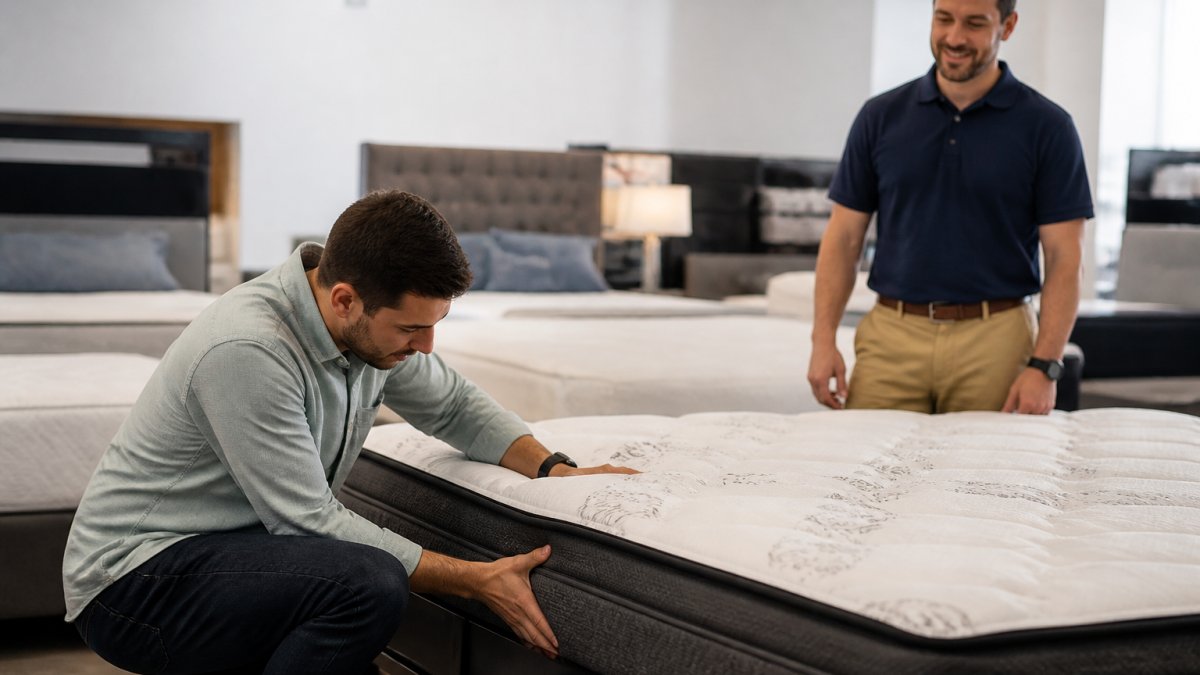
Measurable Criteria to Check in the Showroom
- Foam density, in writing. Ask for the density of every foam layer in pounds per cubic foot (PCF). A support core below roughly 1.5 PCF is a red flag for early compression. Comfort layers below about 3 PCF in memory foam will soften faster than denser foams. Get the numbers on the spec sheet or in an email, not verbal.
- Coil count and gauge. For an innerspring or hybrid, ask for coil count and wire gauge. More coils at a thinner gauge generally means more conforming support; fewer, thicker coils mean a firmer, more durable feel. A queen-size pocketed coil unit commonly runs in the several-hundred range; treat any number far below that as a sign of a lighter build.
- Edge support test. Sit on the corner and then lie across the edge. If you feel yourself sliding off or the edge compresses more than about an inch, the perimeter is weakly reinforced. Strong edge support usually signals a denser core.
- Sagging threshold in the warranty. Find the exact number, many warranties require 1.5 inches or more of visible sagging before a claim is honored. A warranty that excludes sagging entirely is not a durability warranty.
How to Score Two Mattresses Side by Side
Bring this list to the store and score each candidate on a simple pass/fail basis. If you need somewhere to start, our list of affordable mattress stores in Chattanooga shows where you can inspect options in person. A mattress that passes foam density, coil construction, edge support, warranty sagging threshold, and return terms is a genuinely discounted quality build. A mattress that fails two or more of those is a low price attached to a low-quality product, regardless of how it feels in the first five minutes.
Hidden Costs, Returns, and Warranty Fine Print
The sticker price is rarely the full cost. Delivery fees, setup charges, old-mattress removal, and return shipping can add up, and some “free” trials carry restocking fees. Read the return policy before you buy, and confirm whether a warranty covers sagging and how much sagging triggers a claim. At Mattress Outlet of Chattanooga, we keep pricing transparent and offer flexible payment plans and layaway so the price you’re quoted is the price you pay.
Frequently Asked Questions
Do cheap mattresses wear out faster than expensive ones?
Often, yes, but not always. Lower-density foams and thinner coil gauges compress sooner, so a budget mattress may show sagging in three to five years versus seven to ten for a well-built model. The gap narrows when you buy a cheap mattress with a decent support core and use a proper foundation. Check foam density and coil count before assuming price alone predicts wear. A cheap mattress that fits your body weight and sleeping position can last well past the average if you rotate it and use a mattress protector.
Are cheap mattresses worth it for side sleepers and heavier sleepers?
It depends on the sleeper profile. Side sleepers need pressure relief at the shoulder and hip, which usually means a softer comfort layer that budget models sometimes skimp on. Heavier sleepers put more stress on foam density and coil support, so a very cheap mattress may sag early. A $500 mattress with pocketed coils and a denser support core is often the safer floor for these profiles. Back and stomach sleepers on a tight budget can often do well with a firmer cheap mattress.
What mattress should you stay away from?
Avoid mattresses with no material certifications, no written warranty, and no return policy. Skip any listing that won’t state foam density or coil count, and walk away from floor models sold as new or mattresses with visible indentations in the showroom. Be cautious with ultra-low prices that hide shipping fees, restocking charges, or mandatory setup costs. If a seller can’t tell you what’s inside the mattress and what happens if you hate it, that’s the one to leave behind.
How much should you spend on a mattress?
There’s no universal number, but the useful test is cost per year, not sticker price. Divide the price by the realistic lifespan for that construction quality. A cheap mattress at a low price that lasts four years can cost more per year than a mid-priced one that lasts eight. Set a budget you can pay without financing stress, then compare construction details at that price. Shoppers who buy from truckload-priced outlets often get more mattress for the same budget than they would at full retail.
Replacing a worn-out mattress on a budget shouldn’t mean settling for something that sags in a year. At Mattress Outlet of Chattanooga, we offer brand-new mattresses at 60-80% below retail, flexible financing and layaway, and a personalized, appointment-based shopping experience so you can compare options without pressure. Get started with Mattress Outlet of Chattanooga and sleep better for less.
