
How to Spot New Mattresses: 8 Signs You Need One
Table of Contents
- 8 Signs You Need a New Mattress (And How to Spot Them)
- How Long Does a Mattress Last? Lifespan by Material and Use
- The At-Home Inspection Checklist: How to Spot New Mattresses vs. Worn Ones
- How to Test a New Mattress Before You Buy
- New Mattress Expansion Time: What to Expect After Delivery
- Troubleshoot First: Fixes to Try Before You Replace
- When to See a Doctor (And When It’s Just the Mattress)
- Conclusion
- Frequently Asked Questions
Last Updated: October 19, 2026
8 Signs You Need a New Mattress (And How to Spot Them)
A worn mattress is easy to live with and hard to notice. You adapt to it slowly, one stiff morning at a time, until you forget what good sleep feels like. Learning how to spot new mattresses versus tired ones starts with your own body.
Here are the eight signs worth checking, and how to spot each one before another year slips by.
Morning Aches, Stiffness, and Joint Soreness
Waking up sore is the most common sign you need a new mattress. A supportive bed keeps your spine aligned and spreads your weight evenly. A worn one lets your hips and shoulders sink, which puts pressure on joints all night.
Watch for:
- Lower back pain that fades an hour after you get up
- Stiffness in your hips or shoulders
- Numbness or tingling in your arms
If the ache follows you into the day, your mattress is likely the cause.
Visible Sagging, Lumps, and Deep Indentations
Run your hand across the surface. A new mattress feels flat and even. A worn one shows dips where you sleep, lumps under the cover, or a raised ridge down the middle.
Check for:
- Deep indentations where your body rests
- Uneven surface you can feel with your palm
- A visible sag when you look across the bed at eye level
These are mattress replacement signs you can see, not just feel.
How Long Does a Mattress Last? Lifespan by Material and Use
Most mattresses last seven to ten years, but the material and how you use it change that range (How Long Should A Mattress Last?). Age alone does not determine whether replacement is needed, a well-cared-for latex bed can outlast a poorly supported foam bed by several years. What matters is how the support layers fail and how fast your use pattern accelerates that failure.
| Mattress Type | Typical Lifespan | What Speeds Up Wear |
|---|---|---|
| Innerspring | 6-8 years | Heavy use, weak foundation, broken coils |
| Foam | 6-8 years | Body heat, no mattress protector, heavy sleepers |
| Hybrid | 7-10 years | Poor airflow, excess moisture, edge compression |
| Latex | 10-12 years | Direct sun, damp rooms, improper foundation |
Why each material fails the way it does
Innerspring mattresses fail when coils lose tension or break and when the padding above the coils compresses. A weak or flexing foundation accelerates both.
Foam mattresses soften over time as the foam cells compress and take a set where the body rests.
Hybrid mattresses combine a coil support core with foam or latex comfort layers.
Latex is the most durable common material because latex resists compression set better than polyurethane foam. It still degrades when exposed to direct sunlight, damp rooms, or an unsupportive foundation that lets it flex unevenly.
How use patterns change the math
- Two sleepers vs. one: a shared bed breaks down faster because twice the weight and heat hit the same surface every night.
- Weight and sleep position: heavier sleepers and side sleepers put more concentrated pressure on hips and shoulders, which compresses comfort layers faster.
- Foundation type: a proper foundation matched to the mattress spreads load evenly; a mismatched or failing foundation shortens life regardless of material.
- Protector and cleaning: a waterproof protector and regular airing reduce moisture and odor, which are common reasons beds get replaced before the support actually fails.
- Rotation: regular rotation (where the mattress allows it) spreads wear and can add a year or more of comfortable use.
Track your mattress age. If you cannot remember when you bought it, that is a clue in itself, and a reason to inspect the bed rather than guess.
Write the purchase date on the mattress tag with a marker. When you are deciding whether to replace, you will have a real number instead of a guess, and you can compare it against the lifespan range for your material.
The At-Home Inspection Checklist: How to Spot New Mattresses vs. Worn Ones
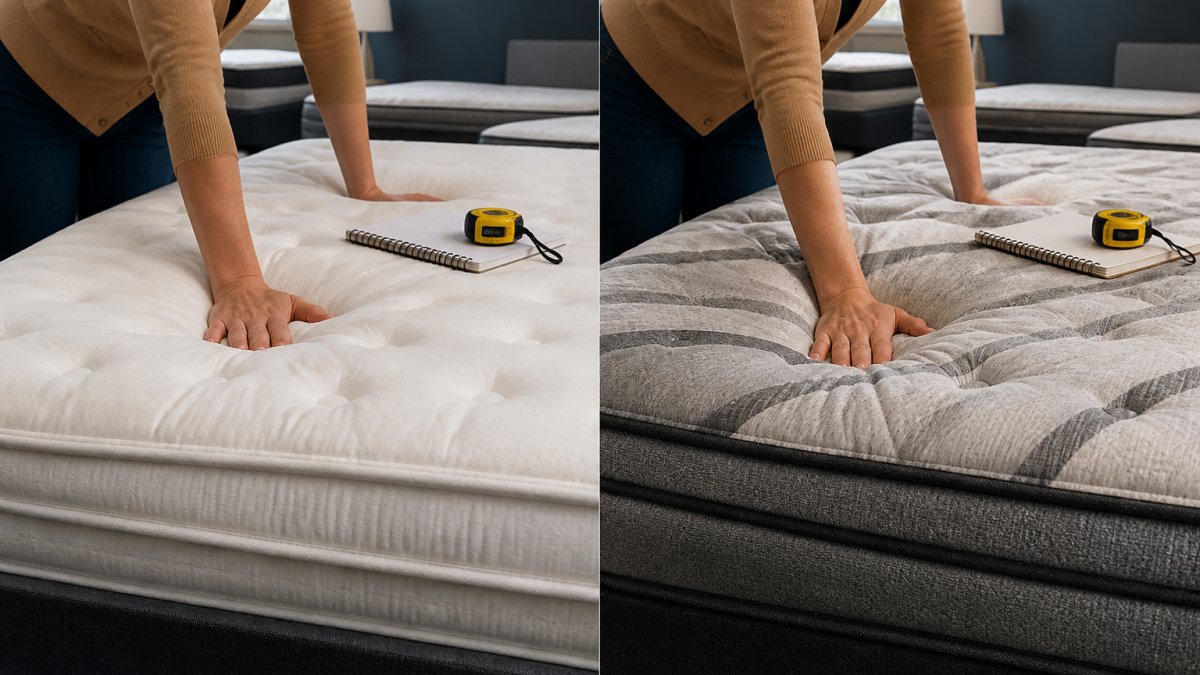
A worn mattress gives itself away in about ten minutes if you know where to look and what to measure. Use this checklist to compare what you have against how to spot new mattresses in a showroom.
1. Measure the sag, don’t just feel it
Lay a straight edge, a yardstick, a level, or a broom handle, across the bed from head to foot and side to side. Measure the gap between the straight edge and the mattress surface at the lowest point. A dip of about 1 inch or more is a visible sag; anything approaching 1.5 inches is a clear replacement signal. Do this in the spots where you and your partner actually sleep, not just the center.
2. Press the center and the edges
Push down firmly with your palm in the middle, at the head, at the foot, and along both edges. A new mattress springs back evenly and quickly. A worn one feels soft or dead in the middle, or the border collapses when you sit on the edge. Edge collapse is a common sign of a broken or compressed border wire or foam encasement, and it usually means the support layer has failed even if the top looks fine.
3. Check the foundation before you blame the mattress
A cracked box spring, a bent metal frame, or broken slats cause dips that look exactly like mattress wear. Pull the mattress off and inspect the foundation. Slats should be evenly spaced and unbroken; box springs should not creak, flex, or show broken coils. If the foundation is failing, replacing the mattress alone will not fix the sag.
4. Look for surface and seam damage
Run your hand across the cover and check the seams and binding. Look for tears, compressed or flattened areas, stains that suggest moisture, and loose or broken stitching. Stains alone do not mean the mattress is worn out, but moisture damage often comes with compressed foam and odor.
Call Us Today (423) 255-8124 → →
5. Test the other side and the other sleeper
If the mattress is flippable, sleep on the unused side for a week. If it is not flippable, rotate it 180 degrees so your head is where your feet were. If you feel noticeably better, the wear is concentrated where you sleep and the mattress is on its way out. If two people share the bed, compare notes, one person may feel the sag more because of weight or sleep position.
6. Compare against your own baseline
Note your mattress age against the lifespan table below, then rate the bed on four things: morning aches, sleep quality, visible condition, and whether you sleep better elsewhere. Two or more failing checks points to a worn bed; one failing check plus a mattress past its expected lifespan is also a reasonable replacement signal.
Photograph the straight-edge measurement and the foundation before you shop. A photo of a 1.5-inch dip is more useful than a memory of “it felt soft,” and it helps you compare honestly when a salesperson asks what is wrong with your current bed.
How to Test a New Mattress Before You Buy
Testing a new mattress takes more than a quick sit. Lie on it for at least ten minutes in your normal sleeping position. Roll from your back to your side. If your shoulders and hips feel pressure, the bed is too firm. If you sink in and struggle to turn, it is too soft.
Ask yourself:
- Does my spine feel straight when I lie on my side?
- Do my shoulders and hips feel pressure relief?
- Can I move without fighting the surface?
A mattress that fits your sleeping position will feel right within minutes.
New Mattress Expansion Time: What to Expect After Delivery
A new mattress expansion time of 24 to 48 hours is normal for most foam and hybrid beds. These mattresses ship compressed and rolled. Once you open the packaging, they need time to regain full shape.
What to do:
- Open the box within a few days of delivery
- Let the mattress rest flat on the foundation
- Wait the full expansion window before judging firmness
- Expect a slight odor that fades within a day or two
Do not sleep on it too early. A half-expanded mattress feels firmer and flatter than it will later.
Troubleshoot First: Fixes to Try Before You Replace
Not every bad night means a new mattress. Try these fixes before you spend anything.
- Add a mattress topper. A firm topper can restore pressure relief on a soft bed.
- Check the foundation. A cracked box spring or sagging slats cause dips that look like mattress wear.
- Rotate the mattress. Flipping or rotating spreads wear and buys time.
- Replace the pillows. Old pillows cause neck and shoulder soreness that mimics mattress problems.
- Clean and air it out. Moisture and dust can make a good mattress feel worse.
If the bed still fails after these steps, replacement is the honest answer.
When to See a Doctor (And When It’s Just the Mattress)
Persistent pain that does not improve after a week on a better mattress deserves a doctor’s visit. A mattress can cause morning stiffness and soreness. It cannot explain chronic pain, numbness that spreads, or pain that wakes you at night.
See a doctor if you notice:
- Pain that lasts all day, not just after waking
- Numbness or weakness in your legs
- Pain that gets worse over weeks
For most people, a supportive new mattress and a proper pillow fix the morning aches. When in doubt, ask a medical professional.
Conclusion
A worn mattress steals your sleep one night at a time, and the signs are easy to miss until you know what to look for. If your inspection checklist fails, Mattress Outlet of Chattanooga can help you find a brand-new bed at a price that fits your budget. We offer truckload pricing that keeps costs well below retail, flexible payment plans and layaway, and a personalized appointment-based shopping experience. Every mattress we sell is brand-new, never refurbished. Get started with Mattress Outlet of Chattanooga and sleep better on a bed built to last.
Call Us Today (423) 255-8124 →
Frequently Asked Questions
How do I know if it’s time for a new mattress?
Look for a cluster of signals rather than one. Waking with morning stiffness, shoulder soreness, or back pain most days, tossing and turning through the night, and visible sagging or deep indentations are the strongest indicators. If you sleep noticeably better in a guest bed or hotel, that is a practical test. Add your mattress age: most foam beds last 7 to 8 years and innerspring beds 7 to 10, so a mattress past that range with any of these symptoms is a strong candidate for replacement.
Can a mattress look fine but still need replacing?
Yes. Visible wear is only one sign of a worn mattress. Support layers break down inside the mattress before the surface shows it, so a bed can look flat and clean while pressure points, spinal alignment, and sleep comfort have already degraded. The tell is how you feel: morning aches, joint pain, restless sleep, and frequent waking that improve when you sleep elsewhere point to internal breakdown. Use the at-home inspection checklist to check for uneven surface and soft spots, not just stains or tears.
How can I tell if my mattress is sagging?
Lay a straight edge, like a broom handle or a long ruler, across the mattress surface. If you can see a gap of more than about 1 inch between the straight edge and the mattress in your usual sleeping area, the surface has dipped. Also press down firmly with your hand across the bed: soft spots that do not spring back quickly signal worn support layers. Compare the center of the bed to the edges, since most sagging shows up where you sleep.
How long should I wait before sleeping on a new mattress?
New mattress expansion time varies by type. Memory foam and other compressed mattresses typically need 24 to 48 hours to fully expand after unboxing, and some need up to 72 hours. Innerspring and hybrid mattresses that arrive uncompressed are ready to sleep on right away. Sleeping on a compressed foam mattress too early can affect how evenly it expands, so give it the full window. Check the manufacturer’s instructions, since expansion time depends on the foam and how long the mattress was boxed.