How to Choose a Mattress Under $1,000 in 2026

Table of Contents

Last Updated: October 13, 2026

Start With Your Sleep Position and Body Type

Learning how to choose a mattress under $1000 starts with two facts: how you sleep and how much you weigh. Get those right and most of the decision makes itself; get them wrong and even a well-built bed can leave you sore.

A mattress under 1000 dollars still delivers brand-new construction, a real warranty, and a sleep trial. At Mattress Outlet of Chattanooga, the happiest shoppers are the ones who matched firmness to sleep position before walking in the door.

Side, Back, Stomach, and Combination Sleepers

Side sleepers need the most cushioning: shoulders and hips press deep into the surface, so a medium or medium-firm feel keeps the spine level.

Back sleepers do best on medium-firm. Stomach sleepers need firm support to keep hips from sinking and arching the lower back. Combination sleepers should prioritize responsiveness so they can change position without fighting the bed.

Weight, Height, and Partner Considerations

Body weight changes how a mattress feels: a lighter sleeper may find a medium-firm bed supportive, while a heavier sleeper sinks through the comfort layer to the support core. Heavier sleepers should lean firmer and look for sturdier coils.

Shopping with a partner? You need a surface that works for both sleep positions, not an average of the two, plus motion isolation so one person’s repositioning doesn’t wake the other.

Match Mattress Firmness for Sleeping Position

Firmness is the most useful filter when choosing a mattress on a budget, because it’s the one spec you can match to your body before comparing price tags.
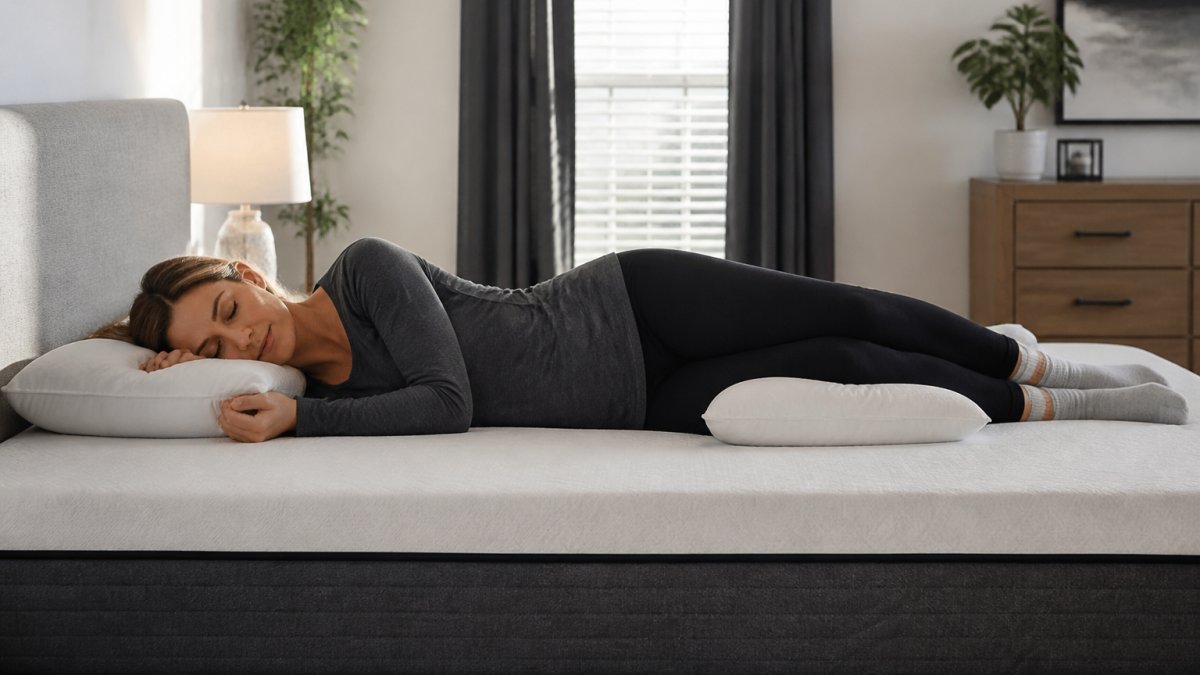
Person lying on their side on a mattress under 1000 with pillows supporting their neck and knees for spinal alignment

Use this as your starting point:

  • Side sleepers: medium to medium-firm, with a pressure-relieving comfort layer
  • Back sleepers: medium-firm, which keeps the lumbar curve neutral
  • Stomach sleepers: firm, so the hips stay level with the shoulders
  • Combination sleepers: medium-firm with responsive foam or coils
  • Heavier sleepers: firm, with a dense support core

Firmness isn’t quality. A firm budget mattress can outperform a soft premium one for a stomach sleeper, so test feel before price.

Pro TipLie on each candidate for a full ten minutes in your dominant sleep position, not thirty seconds on your back. Most people buy the feel they test first, and that’s rarely the position they actually sleep in.

Compare Mattress Types and Materials

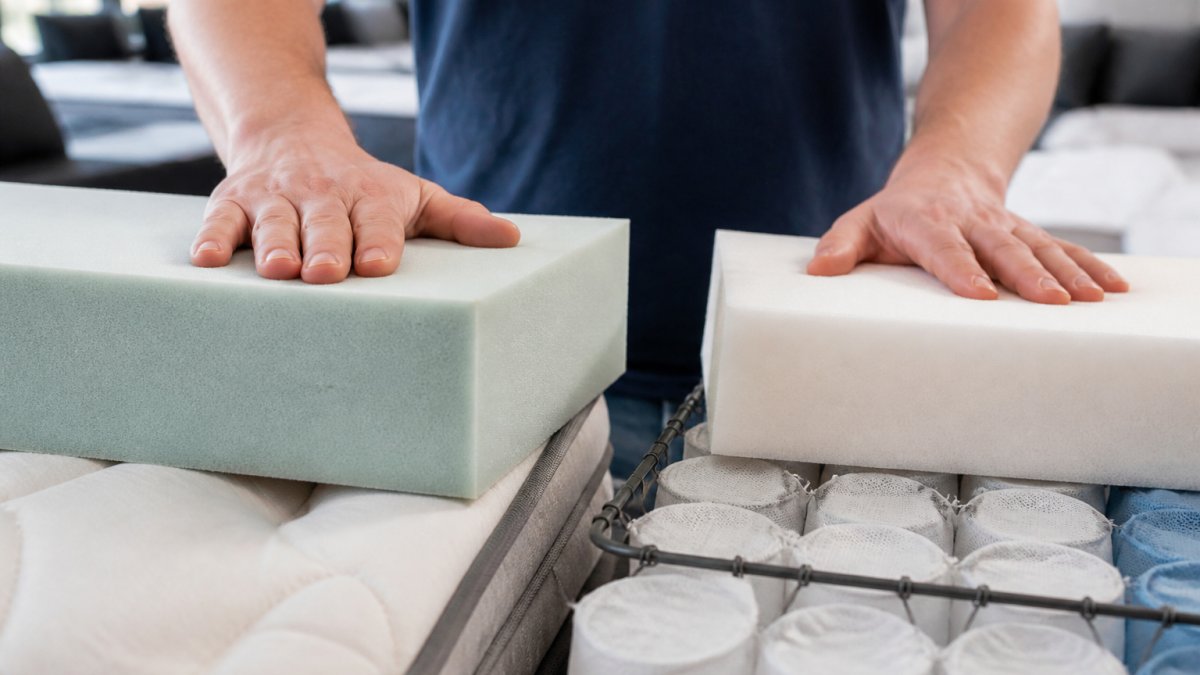
Four constructions dominate the sub-$1,000 market, each trading off differently between price, cooling, and motion isolation. Understanding mattress types and materials tells you what you’re paying for, and what to inspect on the spec sheet before trusting a showroom feel.

Foam, Hybrid, Innerspring, and Latex

Hybrid mattresses pair a coil support core with a foam or latex comfort layer. They sleep cooler than all-foam, add bounce, and are the most common pick for shoppers who want support without giving up cushioning.

Innerspring builds use traditional coils with minimal foam. They’re the firmest and often most affordable, with strong airflow but weaker motion isolation, often the best value per dollar if you sleep hot or alone.

Latex is responsive, durable, and naturally breathable. It costs more per unit than foam, so a latex bed under $1,000 usually means a thinner comfort layer.

Type

Feel

Cooling

Motion Isolation

Best For

Memory foam

Conforming, slow

Lower

Excellent

Side sleepers, couples

Hybrid

Balanced, bouncy

Good

Good

Most sleepers

Innerspring

Firm, traditional

Excellent

Fair

Stomach sleepers, hot sleepers

Latex

Responsive, springy

Excellent

Good

Durable-value shoppers

What to Check on the Spec Sheet

A product page can call a mattress “premium” without telling you anything useful. These details actually predict how a budget bed will perform:

  • Comfort-layer density. Higher-density foams resist softening; low-density foams break down faster.
  • Support-core construction. Coil count, gauge, and perimeter reinforcement affect support and edge stability.
  • Total height and layer order. A thicker comfort layer feels plusher but reduces support; a thinner one feels firmer but may bottom out for heavier sleepers.
  • Certifications. Look for independent testing labels on foam emissions and material safety.

Match the Material to Your Priorities

There’s no single “best” material, only the best fit for how you sleep:

  • If you overheat: prioritize innerspring, hybrid, or latex over all-foam.
  • If you share the bed: prioritize memory foam or a hybrid with strong motion isolation.
  • If you need firm support: prioritize innerspring or a firm hybrid.
  • If you want longevity on a budget: prioritize higher-density foam or latex, even if the layer is thinner.
Pro TipAsk the seller for the density and coil specs in writing before you buy. A retailer that can answer those questions is usually a retailer that will also stand behind the return policy, and those two things tend to travel together.

Foam vs. Hybrid: The Budget Decision

The foam-versus-hybrid choice is the one most budget shoppers face. All-foam beds cost less at a given comfort level and isolate motion better, but sleep warmer and feel sluggish when you change position. Hybrids cost a bit more, sleep cooler, and add bounce that helps combination sleepers move freely, but transmit more motion and may have weaker edge support unless the perimeter is reinforced.

If you sleep hot, share the bed with a restless partner, or rotate positions overnight, a hybrid is usually worth the stretch. If you sleep cool, sleep alone, and want the lowest price for a given plushness, all-foam is often the smarter buy.

Call Us Today (423) 255-8124 → →

Warranties Cover Defects, Not Discomfort

Warranties are separate from trials, and confusing the two is common. A warranty covers manufacturing defects, sagging beyond a stated threshold, a broken coil, a failed seam, not a change of heart about firmness.

When you compare warranties, check:

  • Coverage years and whether coverage is prorated. A long term with prorated coverage is worth less than it sounds.
  • The sagging threshold. Most warranties only kick in after a specific depth of indentation, so a bed that feels unsupportive but hasn’t sagged enough won’t qualify.
  • What voids coverage. Using the wrong foundation, removing the law tag, or skipping a required mattress protector are common disqualifiers.
  • Who pays shipping on a warranty claim. Even a valid claim can cost you if you’re responsible for freight.

In-Store vs. Online: How the Policies Differ

The purchasing route changes your risk profile as much as the mattress does.

Online usually offers longer trials and lower prices, but you’re buying sight unseen and may handle repacking or shipping on returns. Online-only brands often publish policies clearly, but the logistics fall on you.

A practical middle path: test feel in a showroom, then confirm the exact model’s trial, return, and warranty terms in writing before you commit, whether you buy there or online.

Build a Simple Policy Checklist

Before you hand over payment, confirm these five things in writing:

  1. Trial length and any required break-in period.
  2. Return cost, fees, shipping, and who arranges pickup.
  3. Refund type and timeline.
  4. Warranty length, sagging threshold, and what voids it.
  5. Foundation requirements, since the wrong base can void both the trial and the warranty.
Key TakeawayA mattress is only a bargain if you can get out of it. The trial and warranty terms are part of the product, read them before the price tag, not after.

Evaluate Mattress Durability and Lifespan

Mattress durability and lifespan come down to construction quality, not marketing claims. A well-built budget mattress can last as long as a poorly built premium one, so judge materials rather than the label.

Higher-density foams hold their shape longer than low-density ones, and a thicker-gauge coil system resists sagging better than a thin one. A supportive foundation or adjustable base protects the mattress from the flexing that wears it out early.

To judge value over time, divide what you’ll pay by the years you expect to keep the bed, and compare that annual figure across options.

Key TakeawayValue is cost per year of comfortable sleep, not the lowest price on the tag. A durable bed that lasts twice as long can cost less annually than a cheap one you replace sooner.

Understand the Total Cost of a Mattress Under $1,000

The advertised price is rarely the full cost of a mattress under $1,000. Budget for the whole setup.

Beyond the mattress, factor in:

  • Foundation or adjustable base, if your current one isn’t compatible
  • Delivery and setup, which some sellers charge for
  • Old mattress removal, often a separate line item
  • Protector and pillows, small costs that extend the mattress’s life
  • Sales tax, which varies by location

Financing and layaway change the math too. Spreading payments keeps the upfront cost manageable, but confirm whether interest or fees apply. Ask for the out-the-door total before you commit, and check the seller’s website for current pricing.

A mattress under 1000 dollars can be an excellent buy, but only when the all-in number still fits your budget after the extras.

Conclusion

Choosing a mattress under $1,000 is less about the lowest tag and more about matching firmness, materials, and durability to how you actually sleep. Get those three right, read the trial and warranty terms closely, and add up the true total cost before you buy.

Mattress Outlet of Chattanooga makes that process simpler with brand-new mattresses priced well below retail, flexible payment plans and layaway, and a personalized, appointment-based shopping experience.

Call Us Today (423) 255-8124 → and let us help you find a mattress you’ll sleep well on for years.

Frequently Asked Questions

Are there any good mattresses under $1,000?

Yes. Many quality mattresses are available under $1,000, including foam, hybrid, and innerspring models from reputable brands. The key is to focus on construction, materials, and warranty rather than price alone. A mattress under $1,000 can offer solid support and comfort for 7-10 years if you choose the right firmness and type for your sleep position.

What mattress type is best for side sleepers?

Side sleepers typically need a medium to medium-firm mattress that cushions pressure points at the shoulders and hips while keeping the spine aligned. Memory foam and hybrid mattresses often work well because they contour to the body. A mattress that is too firm can cause shoulder and hip pain, while one that is too soft may lead to sagging and poor alignment.

How can you tell if a mattress is durable?

Check the warranty length, foam density, and coil gauge. A longer warranty (10 years or more) usually signals better durability. High-density memory foam (at least 3.5 lb per cubic foot) and tempered steel coils resist sagging. Also, look for reinforced edge support and a breathable cover. Reading owner reviews about how the mattress holds up after a few years can give you real-world clues.

Should you try a mattress in person before buying?

Trying a mattress in person helps you gauge firmness, comfort, and support. Lie on it for at least 10-15 minutes in your typical sleep position. If shopping online, choose a mattress with a generous sleep trial (at least 90 nights) and a hassle-free return policy. Many retailers also offer showrooms where you can test models before ordering.
Same Day Mattress Take Away Chattanooga: 2026 Guide

Table of Contents

Last Updated: October 13, 2026

Same Day Mattress Take Away in Chattanooga: What to Expect

Same day mattress pickup Chattanooga residents can book usually means a crew arrives within hours, not days, to haul away an old mattress, box spring, or full mattress set. When you call before noon, most local haulers can offer a same-day or next-day pickup window. The service handles the heavy lifting: labor, truck, and disposal. What it can’t fix is a mattress left outside in the rain or a building with no loading access. Those details decide whether your pickup happens today or gets rescheduled. Below, we’ll show you exactly how to book fast, what it costs, and how to tell curbside from in-home service.

Key TakeawayThe single biggest factor in getting a same-day slot is calling before noon. Afternoon requests often roll to the next day because trucks are already routed.

How to Book a Mattress Removal Service Fast

Booking a mattress removal service fast comes down to three things: a clear item description, a confirmed address, and a payment method ready. Most providers quote over the phone or online in minutes, then dispatch the nearest truck.

When you call, describe what you have. “One queen mattress and box spring, second-floor apartment, no elevator” tells the dispatcher more than “a bed.” That detail sets the crew size and the price.

What to Have Ready Before You Call

  • Number of items: mattress, box spring, or both as a mattress set
  • Size: twin, full, queen, or king
  • Floor and access: stairs, elevator, narrow hallway, or curbside
  • Condition: dry, wrapped, or stained
  • Your address and a phone number for the driver
  • Payment method, since most crews collect on arrival

Same-Day Booking Timeline

A typical same-day request moves fast. Call before noon, get a quote and pickup window within the hour, then have the mattress staged by the door. Crews usually give a two-to-four-hour arrival window rather than an exact time.

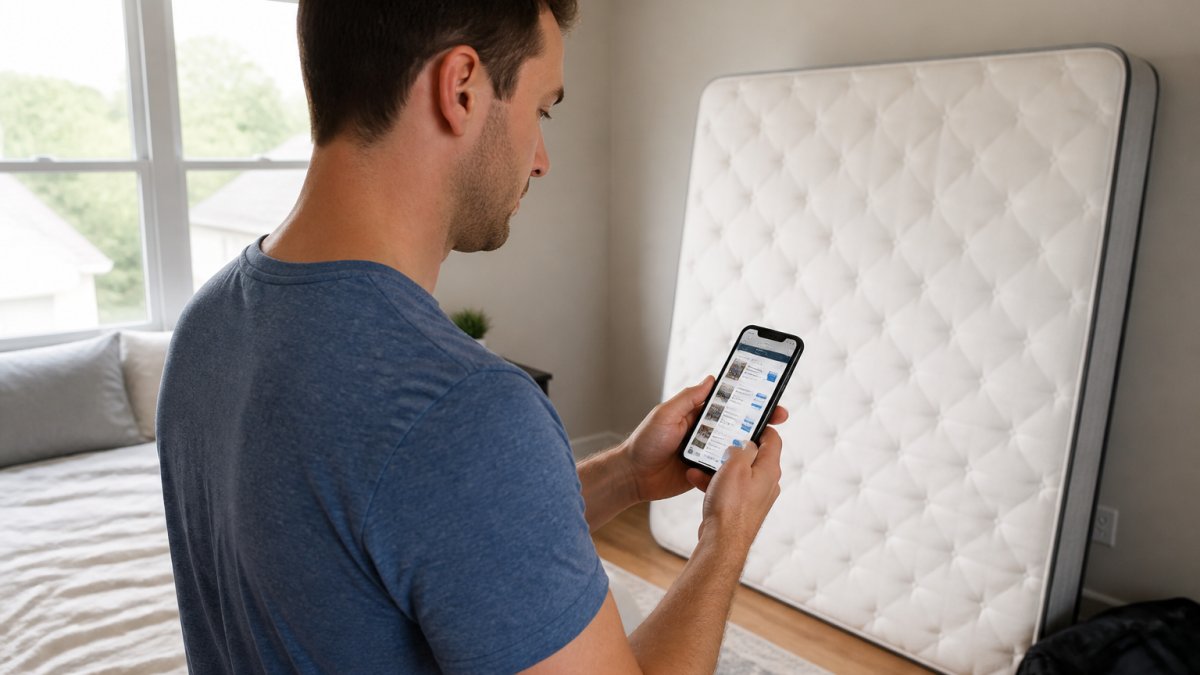
Person using a smartphone to schedule a mattress pickup Chattanooga service in a sunlit bedroom

If you need urgent removal, say so on the call. Last-minute slots open when another job cancels, and a flexible pickup window improves your odds of same-day service.

Mattress Pickup Cost: What Affects the Price

Mattress pickup cost depends on item count, access, and how far the truck travels, not on a flat national rate. A single mattress is the cheapest job; a full bedroom set costs more. What most quotes leave out is how the number is actually built. Here is the breakdown to ask for.

How a Quote Is Built

A typical quote stacks four line items:

  • Minimum charge / trip fee: the base cost of sending a truck and crew, whether you have one item or five. This is why a single mattress rarely prices below the minimum.
  • Per-item fee: added for each mattress, box spring, or furniture piece beyond the first.
  • Labor and access surcharge: added for stairs, elevators, long carries, or a mattress that is not staged at the door.
  • Disposal or recycling fee: the pass-through cost of landfill tipping or recycling processing, which varies by facility.

Ask the dispatcher to separate these four numbers. A quote that only gives a lump sum hides where the money goes and makes it impossible to compare two providers fairly.

What Triggers Extra Fees

  • Stairs and walk-ups: each flight above ground level typically adds labor. A third-floor walk-up is a different job than a ground-floor curbside pickup.
  • Oversized items: king mattresses, heavy hybrid or latex sets, and adjustable bases take more than one person.
  • Same-day or after-hours timing: squeezing a job into an already-routed day can carry a premium.
  • Soiled or unwrapped items: some haulers charge a handling fee for wet, stained, or unwrapped mattresses.
  • Bundled junk: adding a couch, dresser, or bed frame to the same trip usually costs less than a second visit, but it is still an added item fee.

How to Compare Two Quotes

Line up the same four numbers side by side: minimum, per-item, access surcharge, and disposal fee. A lower minimum with a high per-item fee can cost more than a higher minimum that includes disposal. Confirm three things in writing or on the call:

  1. Does the quote include labor, hauling, and disposal, or is recycling billed separately?
  2. Is the price locked once the crew sees the item, or can it change on arrival?
  3. What is the cancellation or reschedule policy if you miss the arrival window?

For current rates, check our pricing page.

Watch OutNever assume a low quote covers everything. If disposal or recycling fees are separate, the final bill can climb well past the number you were given on the phone.
Pro TipPhotograph the mattress and the access path, stairs, doorway, elevator, and send them before the crew is dispatched. Providers that quote from photos tend to give firmer numbers and fewer on-arrival surprises.

Curbside vs. In-Home Pickup: Which Is Right for You?

Curbside pickup means you move the mattress to the curb or driveway and the crew loads it. In-home pickup means the crew enters your home, carries the mattress out, and handles every step. Curbside costs less because it saves labor. In-home is worth it when the mattress is upstairs, heavy, or you simply can’t lift it.

Pickup Type

What You Do

Best For

Cost Impact

Curbside

Move item to curb or driveway

Ground-floor, light items

Lowest

In-home

Nothing; crew carries it out

Stairs, heavy sets, apartments

Higher

Single-item pickup

Stage one mattress

Quick one-off removal

Moderate

Full junk removal

Point to what goes

Estate cleanout, moves

Highest

If you’re moving out of an apartment or handling an estate cleanout, in-home pickup saves your back and your time. For a single old mattress on a ground floor, curbside is the practical choice.

Mattress Recycling and Donation Options

Mattress recycling keeps foam, steel springs, and fabric out of landfills by breaking the bed into reusable materials. Donation is the better path when the mattress is clean, stain-free, and still supportive. The gap most guides skip is the eligibility detail: what actually gets accepted, what gets rejected, and what your local disposal rules allow.

Donation Eligibility: What Gets Accepted

Charities and reuse programs generally accept a mattress only if it meets all of these:

  • No stains, tears, or odors. Visible staining or a musty smell is an automatic rejection at most donation centers.
  • Structurally sound. No sagging, broken springs, or collapsed edges, the bed must still be usable as a bed.
  • Clean and dry. A mattress left outside in the rain is a disposal item, not a donation.
  • Often wrapped or bagged. Many centers require a mattress bag or plastic wrap before they will take it, both for hygiene and handling.

Call the donation center before you load the mattress. Acceptance rules vary, and a rejected drop-off means you are now hauling a mattress twice.

Recycling: What Actually Gets Recovered

A mattress recycling operation separates the bed into its component materials:

  • Steel: the innerspring coils and any metal frame components, sold as scrap.
  • Foam: polyurethane and memory foam, often shredded for carpet padding or cushioning.
  • Fabric and fiber: the quilted cover and batting, sometimes downcycled into industrial products.
  • Wood: box-spring frames and slats, where present.

Not every material stream is recoverable in every market, so ask the hauler whether they recycle or simply landfill. A provider that recycles will usually say so directly; one that dumps will often dodge the question.

Municipal Disposal Rules and Alternatives

Public disposal options vary widely, and many curbside trash programs will not take a mattress at all without a fee, a special tag, or a scheduled bulky-item pickup. Before you drag anything to the curb:

  • Check your local solid-waste or public-works department for bulky-item rules, tag requirements, and per-item fees.
  • Ask about mattress-specific bans. Some disposal facilities no longer accept mattresses in the general waste stream and route them to recycling instead.
  • Confirm the drop-off location and hours. Public convenience centers and transfer stations often have limited bulky-item windows.
  • Keep it dry and wrapped until pickup, whether the collector is public or private.

If a public option is cheaper but requires you to transport the mattress yourself, weigh that against the labor and vehicle space. For most households, a private hauler that handles labor, transport, and disposal in one trip is the simpler path, and the one that lets you choose recycling over landfill.

Pro TipBag or wrap a stained mattress before pickup. Many donation centers and some recyclers reject unwrapped, soiled beds on sight, and the crew may charge a handling fee instead.

Same-Day Junk Removal for Furniture and More

Same-day junk removal handles more than mattresses. If you’re clearing a room, haulers can take furniture removal, old bed frames, dressers, and general clutter in one trip. Bundling saves money because you pay for one truck visit instead of three.

This matters during apartment moves and estate cleanouts, when a mattress, a couch, and a broken dresser all need to go at once. Tell the dispatcher everything you want removed so the truck arrives sized for the job. A single-item pickup is fine for one mattress, but a full load is more efficient when you have a house to clear.

One distinction worth keeping straight: mattress pickup for disposal removes your old bed. Mattress delivery brings a new one in. If you’re replacing a worn-out mattress, you may need both, and some retailers coordinate the swap so the old bed leaves as the new one arrives.

At Mattress Outlet of Chattanooga, we sell brand-new mattresses at 60-80% below retail through truckload pricing, with flexible payment plans and layaway. When you’re ready to replace the old bed, our team can point you toward pickup options.

Frequently Asked Questions

Why can’t I just put a mattress in my dumpster?

Many municipal waste services and private haulers do not accept mattresses in standard dumpsters because they are bulky, don’t compact well, and can damage equipment. Some landfills also ban them due to the foam and metal components. In Chattanooga and surrounding areas, you’ll typically need to schedule a dedicated mattress pickup or drop it at a facility that accepts large items. Checking local disposal rules before you haul it to the curb saves you a wasted trip and potential fines.

How much does mattress pickup cost in Chattanooga?

Mattress pickup cost depends on factors like whether it’s curbside or in-home, the number of items, and how quickly you need it removed. Same-day or next-day service often carries a premium. Some providers charge per item, while others bundle mattress removal with other junk removal. For transparent pricing, check the provider’s website or call for a quote. Many local services offer upfront pricing so you know the total before they arrive.

Can I get a mattress picked up the same day I call?

Same-day mattress pickup in Chattanooga is often possible if you call before noon and the provider has availability. Have your address, mattress size, and access details ready when you book. Some services offer real-time quotes online and can schedule a pickup window within hours. If same-day isn’t available, next-day pickup is a common fallback. Booking early in the day gives you the best chance of securing a same-day slot.

What should I ask before booking mattress removal?

Ask about the total cost, including any fees for stairs or heavy items. Confirm whether the service includes in-home pickup or curbside only. Check if they recycle or donate mattresses instead of sending them to a landfill. Ask about the pickup window and whether they call ahead. Finally, confirm they are licensed and insured. Getting these details upfront prevents surprises and ensures your old mattress is disposed of responsibly.


Replacing a mattress shouldn’t mean juggling haulers, fees, and guesswork. Mattress Outlet of Chattanooga makes the swap simple with brand-new mattresses priced 60-80% below retail, Ashley Furniture Direct options, and flexible layaway and payment plans that fit real budgets. Call us today at (423) 255-8124 and get the old bed gone and a better night’s sleep on the way.

Best Mattress Brands for Longevity: What Actually Lasts

Table of Contents

Last Updated: October 8, 2026

What Determines How Long a Mattress Actually Lasts

A mattress’s lifespan depends on three factors: construction type, material quality, and maintenance. The best mattress brands for longevity invest in high-density foams, heavy-duty coil systems, and durable covers that resist wear and sagging.

Construction quality matters most. A mattress with reinforced edge support, individually wrapped coils, and premium foam layers outlasts a budget model with thin materials.

Maintenance habits extend lifespan significantly. Rotating every three months, using a quality foundation, and protecting against moisture all help. A well-maintained mattress can outlast a neglected one that started with better construction.

Mattress Lifespan by Type: Construction Matters

Construction type determines whether you’re investing in a seven-year mattress or a twelve-year one.

Innerspring and Coil Mattresses

Innerspring mattresses typically last 5-7 years. The coil system is the core support structure, and its gauge (thickness) directly affects durability: heavier-gauge coils resist compression better.

Coil quality matters more than count. A mattress with 400 heavy-duty coils often outlasts one with 600 thin coils.

Padding layers wear faster than coils. Budget innersprings use thin foam or polyester batting that compresses quickly; premium models add memory foam or latex that holds up longer, extending life to 7-8 years.

Memory Foam and Polyurethane Mattresses

All-foam mattresses typically last 6-8 years. Foam density is the key durability metric: higher-density foam resists impressions and sagging better.

Memory foam loses its ability to spring back over time, at a rate set by density and weight load. A 5-pound-per-cubic-foot foam sags noticeably within five years; a 7-8 pound density maintains support longer.

Polyurethane foam, common in budget mattresses, lasts only 4-5 years and compresses under sustained pressure. Premium all-foam models use multiple layers of varying densities to distribute weight and reduce compression in any single layer.

Hybrid Mattress Performance

Hybrid mattresses combine coil support with foam comfort layers, often delivering 7-9 years. The coil base provides structural integrity while foam adds pressure relief and motion isolation.

Hybrids outlast all-foam mattresses because the coil system prevents uniform sagging: when foam compresses, the coils still provide foundational support. That’s why many of the most durable mattress brands use hybrid construction.

Hybrids are heavier and pricier than pure foam, but if longevity is the priority, the structure justifies the investment.

Latex Mattresses

Natural and synthetic latex mattresses often last 8-10 years or longer. Latex resists compression and maintains its shape through years of use.

Latex durability comes from its molecular structure: unlike polyurethane foam, which breaks down as cells collapse, latex maintains elasticity under extended pressure.

Latex costs significantly more upfront, but the extended lifespan means a lower cost per year of use.

Durable Mattress Materials That Resist Sagging and Wear

The materials inside your mattress determine how well it resists impressions and sagging.

Infographic comparing high-density foam and coil structures used by the best mattress brands for longevity

Foam density is measured in pounds per cubic foot.

Coil gauge and type matter for innerspring and hybrid models. Lower gauge numbers mean thicker wire (14-gauge is heavier-duty than 16-gauge).

Cover materials matter too. Quality polyester or cotton blends resist pilling and tearing better than cheap fabrics, and reinforced edges prevent separation over years of use.

Edge support reinforcement is often overlooked but critical.

The specs that actually predict longevity

A brand’s durability story lives in its published specifications. When a manufacturer discloses these numbers, you can compare models directly instead of trusting adjectives:

  • Core foam density. Look for support-core polyurethane foam at 1.8 lb/ft³ or higher, and memory foam comfort layers at 4 lb/ft³ or higher. Foam below roughly 1.5 lb/ft³ in a support layer is the single most common cause of early body impressions.
  • Coil gauge and count. Innerspring and hybrid cores commonly use 13-15 gauge wire; lower gauge numbers mean thicker wire and better resistance to compression. Coil counts in the 700-1,000 range (queen) are typical for premium hybrids, but gauge and coil design matter more than raw count.
  • Edge support type. Foam-encased or coil-based perimeter reinforcement holds its shape far longer than a mattress with no dedicated edge system.
  • Cover and fire-barrier construction. Tightly woven covers and quilted (rather than glued) fire barriers resist delamination and pilling over time.

Why brand reputation alone is a weak signal

A well-known brand can sell both a 10-year hybrid and a 4-year budget foam under the same logo. Longevity is a property of the model and its materials, not the label. Evaluate published specs, warranty language, and multi-year owner reports together, and treat “lasting decades” claims without supporting specs as marketing, not evidence.

Learn More → →

Key TakeawayJudge a brand by whether it publishes foam densities, coil gauges, and edge-support details, and by how its warranty defines sagging. Those three data points predict longevity better than brand recognition.

Mattress Warranty and Durability: What Coverage Really Means

A warranty is a legal promise about defects, not a prediction of comfort lifespan. Pairing that distinction with a cost-per-year calculation is the most reliable way to judge long-term value.

What a warranty does and does not cover

Most mattress warranties cover manufacturing defects: broken coils, sagging beyond a stated threshold, and cover or seam defects. They typically do not cover:

  • Normal softening or body impressions below the stated sag threshold (commonly 1.5 to 2 inches)
  • Damage from an unsupportive foundation or improper bed frame
  • Stains, which usually void coverage entirely
  • Comfort preference changes

That’s why a 10-year warranty doesn’t mean a 10-year mattress, it means replacement if the mattress fails in a specific, defined way within that window.

Warranty terms worth comparing

  • Sag threshold. A warranty that covers impressions over 2 inch is stronger than one that requires 2.5 inches.
  • Proration. Some warranties are fully covered for the first several years and then prorated, meaning you pay a percentage of the replacement cost as the mattress ages.
  • Transferability. A transferable warranty can add resale or hand-me-down value.
  • Proof of purchase and foundation requirements. Most brands require the mattress to be used on an approved foundation; using the wrong base can void coverage.

Total cost of ownership: the number that matters

Warranty length is a weak proxy for value. The stronger metric is cost per year of expected use: divide the purchase price by the years you realistically expect the mattress to stay supportive.

  • A $500 mattress that stays comfortable for 5 years costs about $100 per year.
  • A $1,000 mattress that stays comfortable for 8 years costs about $125 per year.
  • A $1,500 mattress that stays comfortable for 12 years costs about $125 per year.

The cheapest mattress isn’t automatically the best value, nor the most expensive the worst. The math rewards models that hold support long relative to price, so run this calculation on both before deciding.

Where warranties fit into the calculation

Treat the warranty as a safety net, not a lifespan guarantee. It reduces your downside if the mattress fails early but doesn’t extend comfort life. The factors that do are the ones you control: a supportive foundation, a waterproof protector, regular rotation, and materials matched to your body weight and sleeping position.

Watch OutA long warranty is not evidence of long life. Always check the sag threshold, proration schedule, and who pays shipping before treating warranty length as a durability signal.

How to Extend Your Mattress Lifespan: Maintenance and Care

Simple maintenance can add 2-3 years to your mattress’s life.

Rotate every three months. Rotation distributes wear evenly; without it, the same areas compress repeatedly, creating permanent impressions.

Use a quality foundation. A worn box spring or weak frame forces the mattress to sag in the middle.

Protect from moisture. Moisture accelerates foam breakdown and mold growth.

Clean the surface regularly. Dust and debris break down fabrics over time. Vacuum monthly and spot-clean stains promptly.

Durability by Sleeper Profile: Who Gets the Most Years

Lifespan varies by body weight, sleeping position, and number of users.

Side sleepers concentrate pressure on shoulders and hips, creating localized compression; back sleepers distribute weight more evenly; stomach sleepers pressure the lower back and hips.

Couples wear mattresses faster than single sleepers: two people create more total pressure, and one partner’s movement stresses the structure.

Hot sleepers who sweat heavily should invest in moisture-resistant covers and cooling gel foams. Excess moisture accelerates breakdown of standard foam materials.

Pro TipIf you’re a heavier sleeper or sleep with a partner, prioritize hybrid mattresses with reinforced support systems and high-density foams. They maintain support longer under sustained pressure.

Total Cost of Ownership: Price Versus Years of Use

The cheapest mattress isn’t always the most economical once you factor in lifespan.

Consider your timeline: if you move frequently or plan to replace the mattress in five years, a budget model makes sense.

Mattress Outlet of Chattanooga helps customers find durable options at significant savings. By sourcing quality mattresses through smart truckload pricing, we offer brand-new mattresses at 60-80% below retail prices.

Calculate total cost of ownership by dividing mattress price by expected lifespan. A $600 mattress lasting seven years costs about $86 per year.


Finding the best mattress brands for longevity means prioritizing construction quality, material durability, and proper maintenance over initial price. When you’re ready to invest in a mattress built to last, Mattress Outlet of Chattanooga offers durable, brand-new options with flexible payment plans and significant savings.

Frequently Asked Questions

What type of mattress is best for longevity?

Latex and high-quality hybrid mattresses typically last longest, often 8-10+ years. Latex resists sagging better than foam; hybrids combine durable coil support with foam comfort. Innerspring mattresses with heavy-duty coils and high coil gauge (lower numbers = thicker wire) also perform well. Memory foam alone tends to compress faster, usually lasting 6-8 years. Your mattress lifespan depends on construction quality, foam density (5+ pounds per cubic foot is durable), and how well you maintain it through rotation and proper support.

How long should a good mattress last?

A quality mattress should last 7-10 years with proper care. Budget mattresses may show sagging or body impressions within 5-6 years. Premium construction—thick coil gauges, high-density foam, and durable materials—extends lifespan to 10+ years. Factors affecting durability include body weight, sleeping position, mattress rotation frequency, and foundation support. A mattress warranty often reflects expected lifespan; longer coverage (10-15 years) signals manufacturer confidence in durability.

Do latex mattresses last longer than memory foam mattresses?

Yes, latex mattresses typically outlast memory foam. Natural or synthetic latex resists body impressions and sagging better, often lasting 8-10+ years. Memory foam compresses over time and usually lasts 6-8 years, though high-density foam (5+ pounds per cubic foot) performs better than lower-density versions. Latex’s resilience means it bounces back after pressure, while foam gradually loses support. For maximum longevity, choose latex or hybrid designs with substantial coil support and high-density foam layers.

What mattress materials are most durable?

Natural latex, high-coil-gauge innerspring systems, and high-density polyurethane foam resist wear best. Latex offers superior resilience and resists sagging; coils with lower gauge numbers (thicker wire) provide lasting support; high-density foam (5+ pounds per cubic foot) maintains shape longer than low-density alternatives. Hybrid mattresses combining these materials extend lifespan significantly. Avoid low-density foam (under 3 pounds per cubic foot) and thin coil systems, which deteriorate faster. Quality edge support also prevents premature sagging at mattress borders.

What Is a Reasonable Price to Pay for a Mattress?

Table of Contents

Last Updated: October 6, 2026

How Much Should You Actually Pay for a Mattress in 2026?

If you’re asking what is a reasonable price to pay for a mattress, the honest answer is that a reasonable price matches the mattress to your body, your sleep position, and how long you plan to keep it.

Article image

Infographic comparing mattress price tiers and features to help determine what is a reasonable price to pay for a mattress.

Here’s the part most guides get wrong: the tag tells you almost nothing about value. A mattress is a long-term purchase, so the price only makes sense divided by the years you’ll sleep on it.

Why Mattress Prices Vary So Much

Mattress prices swing wildly because four things drive cost: size, construction, materials, and where you buy it. A king of the same model costs far more than a twin because it uses more material, and a showroom’s overhead gets baked into every tag.

The single biggest swing factor is the sales channel. Before you compare prices, check the Federal Trade Commission guidance on buying mattresses, which explains labeling and disclosure rules that affect what you’re actually buying.

Average Cost of a Mattress by Size

Size is the most predictable driver of mattress cost. A bigger mattress needs more foam, coils, fabric, and labor, so the price climbs with every step up in dimensions, even when the build is identical.

The ranges below reflect what shoppers commonly see across entry-level, mid-range, and premium builds.

Size

Typical Dimensions

Who It Suits

Common Price Range

Twin

About 38″ x 75″

Kids, guest rooms, bunk setups

Roughly $150-$1,000

Twin XL

About 38″ x 80″

Tall sleepers, dorm rooms

Roughly $200-$1,200

Full

About 54″ x 75″

Single adults, smaller bedrooms

Roughly $300-$1,500

Queen

About 60″ x 80″

Couples, most primary bedrooms

Roughly $400-$2,500

King

About 76″ x 80″

Couples who want space, large rooms

Roughly $600-$3,000

California King

About 72″ x 84″

Taller sleepers, long bedrooms

Roughly $700-$3,000

A queen sits in the middle of that range, which is why it’s the most common size shoppers ask about.

If you’re furnishing multiple bedrooms, two twins often stretch a budget further than one king.

Pro TipCompare prices at the same size and the same construction. A $700 queen hybrid and a $700 queen all-foam mattress are not the same value, the hybrid packs two support systems into the same footprint.

Why the Same Size Can Cost Twice as Much

Two queens can sit $800 apart on the same showroom floor. The gap comes down to coil count and gauge, foam density and thickness, edge support, and the brand’s marketing budget.

Size alone never tells you whether a price is reasonable. Use the size range to set your ceiling, then use construction and durability to decide where inside that range you land.

Mattress Cost by Type: Memory Foam, Hybrid, Innerspring, and Latex

Construction matters as much as size. Each mattress type uses different materials, and those materials set the floor and ceiling of what you’ll pay. Knowing the four main builds helps you compare apples to apples.

How Much Should You Really Spend on a Mattress? (Our Mattress Budget Guide)

Mattress Makers

  • Memory foam: All-foam construction that contours to the body and isolates motion. Generally the most affordable type, with cost rising as foam density and thickness increase.
  • Hybrid: Foam comfort layers over a coil support core. Combines pressure relief with bounce and airflow, and typically costs more than all-foam because it uses two systems.
  • Innerspring: A traditional coil core with minimal foam. Often the lowest-priced option, though comfort varies widely by build quality.
  • Latex: Natural or synthetic rubber that’s responsive and long-lasting. Usually the most expensive type because latex is costly to produce.

The Sleep Foundation’s mattress type comparisons breaks down how these constructions differ in feel and support, which is worth a look before you commit to a type.

Entry-Level, Mid-Range, and Premium Price Tiers

Within every mattress type, you’ll find three rough tiers. Entry-level covers the basics: a standard support core and simple comfort layers. Mid-range adds better foams, more coils, or cooling features.

Here’s the trap: a premium price doesn’t guarantee better sleep. The jump from entry-level to mid-range usually delivers the biggest real-world improvement, while mid-range to premium is often about features you may never notice.

Key TakeawayMatch the tier to your needs, not to the price tag. A back sleeper who runs hot may get more from a mid-range cooling hybrid than from a premium mattress built for side sleepers.

Mattress Price vs. Quality: What You Get at Every Price Point

Higher prices buy better materials, but only up to a point.

What actually changes as price rises:

  • Support core: More coils or denser foam, which affects durability and how evenly the mattress holds you.
  • Comfort layers: Thicker, higher-quality foams that resist sagging and sleep cooler.
  • Edge support: Stronger perimeter support so you can use the full surface of the bed.
  • Warranty length: Longer coverage, which signals the maker’s confidence in durability.

The Consumer Product Safety Commission information on mattress flammability standards is a useful reminder that every mattress sold must meet federal safety rules, so a lower price doesn’t mean lower safety.

Learn More → →

This is where price-adjusted durability matters. A budget mattress that lasts several years can cost less per year than a premium mattress that outlasts it only slightly.

A Practical Method to Set Your Mattress Budget

Set your budget by working backward from cost per year, not the sticker price. This keeps you from overpaying for unused features or underpaying on a mattress you’ll replace too soon.

Follow these steps:

  1. Decide how long you want the mattress to last. A longer horizon justifies a higher upfront price.
  2. Estimate your cost per year. Divide the price by the years you expect to keep it.
  3. List your must-haves. Cooling, pressure relief, motion isolation, or adjustable-base compatibility.
  4. Match the tier to those needs. Buy the cheapest tier that delivers your must-haves.
  5. Check the purchase terms. Warranty, sleep trial, and return policy change the real value.
  6. Confirm the total cost. Delivery, setup, a foundation, and a mattress protector all add up.
Pro TipAsk whether the price includes delivery and setup, and whether you need a new foundation. A mattress that seems cheaper can cost more once you add a box spring, a protector, and haul-away fees.

Factor In Total Cost of Ownership

Total cost of ownership is the price plus everything needed to use and keep the mattress: foundation or adjustable base, protector, delivery, setup, and return or exchange fees.

Warranty and sleep trial terms belong in this calculation too. A generous trial and straightforward return policy reduce your risk, which has real value. Read the fine print and ask what voids the warranty.

Mattress Sale and Discount Tips: How to Pay Less Without Sacrificing Quality

You can pay less without settling for less if you know where the markup lives. The biggest savings come from cutting retail overhead, not chasing the deepest advertised discount, a discount is only meaningful against a baseline you can verify.

Watch OutA ‘sale’ price means nothing without a baseline. If a seller can’t tell you what the mattress normally sells for, whether it’s brand-new and unused, and what the return terms are, walk away. Deep discounts on used or returned mattresses are not savings.

Total Cost of Ownership: The Number That Actually Matters

The sticker price is only one line in the budget. Add these before deciding which mattress is cheaper:

  • Foundation or adjustable base. A new foundation can add a few hundred dollars; an adjustable base can add several hundred more.
  • Mattress protector. Often required to keep the warranty valid.
  • Delivery and setup. Sometimes included, sometimes $50-$150 or more, especially for upstairs delivery or old-mattress haul-away.
  • Old mattress removal. Frequently a separate fee.
  • Financing interest. A 0% promotional period that converts to a high APR can quietly raise the price.

A $600 mattress with a $200 foundation, $80 protector, and $100 delivery costs $980 out the door. A $900 mattress that includes all three is the better deal. Run the math on the total, not the tag.

Cost Per Year: The Value Test

Divide total cost by the years you expect to keep the mattress. A $1,200 mattress lasting 10 years costs about $120 per year. A $500 mattress that sags in 3 years costs about $167 per year, and you’ll shop again sooner.

Warranty length is a useful signal. A 10-year warranty suggests the maker expects the build to hold up; a 1-year warranty says the opposite.

Where the Real Savings Come From

  • Buy brand-new, not refurbished. Ask directly whether a mattress is new and unused.
  • Shop truckload and outlet pricing. Buying in volume lets sellers pass savings to you.
  • Skip the flagship markup. The same construction often sells for far less outside traditional retail.
  • Time it around model changes. Outgoing models get discounted when new ones arrive.
  • Ask about flexible payment plans. Financing and layaway spread the cost without raising it, provided the terms are transparent.
Key TakeawayThe best deal is not the lowest price, it’s the lowest cost per year after delivery, setup, a protector, and the return terms are all counted. A slightly higher price with a real trial period and a 10-year warranty is often the cheaper mattress in the long run.

Conclusion: Paying a Fair Price for a Better Night’s Sleep

The hardest part of mattress shopping isn’t finding a low price, it’s knowing whether that price is fair. Work backward from cost per year, match the tier to your real needs, and read the purchase terms before you commit.

Mattress Outlet of Chattanooga makes that math easier. We offer brand-new mattresses and quality furniture from Ashley Furniture Direct, truckload pricing that keeps costs well below retail, and flexible payment plans and layaway for shoppers with limited credit.

Frequently Asked Questions

How much should I pay for a good quality mattress?

A reasonable mattress price depends on size and type. You do not need to spend premium prices to get solid support and durability. Focus on materials, warranty length, and sleep trial terms rather than a specific dollar amount. Many shoppers find that a well-constructed mattress at a mid-range price outperforms a cheap entry-level option within a few years. Always compare cost per year of expected use, not just the upfront price.

Is $500 a lot for a mattress?

For a twin or full size, $500 can buy a solid mid-range mattress with good support. For a queen or king, $500 typically lands in the entry-level tier. Whether it is ‘a lot’ depends on your budget and how long you expect the mattress to last. A $500 mattress that lasts five years costs about $100 per year. A $1,000 mattress that lasts ten years costs the same annually. Compare cost per year, not just the sticker price.

What affects the price of a mattress?

Several factors drive mattress cost: size (twin, full, queen, king), materials (memory foam, latex, coils, hybrid construction), thickness, special features like cooling gel or adjustable base compatibility, brand markup, and where you buy. Delivery, setup, and warranty terms can also add to the total. Mattress price vs. quality is not always linear. Some mid-range mattresses use the same core materials as premium models but skip expensive marketing and retail markups.

How can I tell if a mattress is worth the price?

Check the warranty length, sleep trial period, and return policy fine print first. A mattress with a 10-year warranty and a 100-night trial signals confidence in durability. Next, compare materials: denser foams and higher coil counts generally last longer. Finally, calculate cost per year by dividing the price by the expected lifespan. A mattress that costs more upfront but lasts twice as long often delivers better value for money than a cheaper option you replace every few years.

How Long Do Hybrid Mattresses Last? A 2026 Guide

Table of Contents

Last Updated: October 10, 2026

How Long Do Hybrid Mattresses Last? The Real Answer

Most hybrid mattresses last 6 to 10 years, with seven to eight typical for a mid-quality model. Higher-end hybrids with denser foams and thicker coils often reach 10 to 12 years; budget hybrids wear out closer to six.

The range is wide because how long hybrid mattresses last depends more on what’s inside them and how you treat them than on the label.

A hybrid doesn’t die on a schedule, it dies when its support gives out.

Below: why estimates vary, how to inspect your mattress in ten minutes, and what extends its life.

Key TakeawayA hybrid mattress is a mattress built with a coil support core topped by foam comfort layers. Its lifespan is set by whichever fails first: the coils or the foam.

What “End of Life” Actually Means

The second reason estimates diverge: nobody agrees on when a mattress is dead.

Three definitions are in play:

  • Structural failure. A coil breaks, a foam layer crushes permanently, or edge support collapses. Objective, and often covered by warranty.
  • Functional failure. The mattress holds together but no longer keeps your spine aligned or relieves pressure. This drives most replacements, and it’s subjective.
  • Preference change. The mattress is fine, but you want something firmer, cooler, or bigger. Survey data counts this as a replacement even though nothing failed.

A durability lab measuring structural failure might rate a mattress at 10 years; the owner might hit functional failure at year seven. Both are correct answers to different questions.

The Variables That Actually Move the Number

Strip out the measurement noise and a handful of physical factors drive the real timeline:

  • Foam density. Measured in pounds per cubic foot. Lower-density foams compress and lose rebound faster; a denser comfort layer resists body impressions longer, which is the biggest reason premium hybrids outlast budget ones.
  • Coil gauge and count. Thinner wire fatigues sooner; a higher coil count spreads load across more contact points.
  • Sleeper weight and concentration. A 240-pound sleeper who stays in one position stresses the foam far more than a 140-pound sleeper who moves around.
  • Foundation type. A weak or flexing base lets the mattress bend where it wasn’t engineered to, accelerating foam breakdown and coil fatigue.
  • Rotation habits. Rotating spreads compression instead of letting it concentrate in one zone.

So when you read “hybrid mattresses last 8 years,” that’s a blended midpoint built from mixed measurement methods. Your mattress may beat it or miss it, and now you know which factors decide which.

Key TakeawayA lifespan number is only meaningful if you know what was measured. Warranty periods, blended averages, and roller tests answer three different questions, and none of them is “how long will this feel good to me.”

Signs You Need a New Mattress

The clearest sign you need a new mattress is a visible sag or dip where you sleep that doesn’t bounce back within a few minutes of getting up.

Person testing the edge of a mattress to see how long hybrid mattresses last before sagging.

But “it feels worn out” is not a diagnosis. Before you spend money, run this ten-minute inspection, no tools beyond a straightedge and tape measure, to separate normal settling from genuine failure.

The Ten-Minute Mattress Inspection

Step 1: Strip the bed and look from directly above. Stand at the foot of the bed and sight down the surface.

Rule of thumb: impressions under about three-quarters of an inch are normal settling.

Step 3: Test the edges. Sit on each corner and along each side, then stand up. The edge should push back and recover.

Step 5: Listen and feel for coil problems. Press down and release slowly.

Step 6: Lie down in your normal position for ten minutes. This functional test matters most.

Normal Settling vs. a Replacement-Level Problem

Every mattress settles. The question is whether you’re feeling expected break-in or actual failure:

  • Normal settling: shallow impressions under about three-quarters of an inch, even softening, foam that recovers within minutes, no change in how your body feels in the morning.
  • Replacement-level problem: impressions deeper than roughly an inch, a dip concentrated in one zone, foam that stays compressed, coils you can feel, new noise, or waking up sore in the same spots most mornings.

The pattern matters as much as the depth. A mattress that softened evenly is usually still supportive; one with a deep crater where you sleep has failed locally, and that’s the failure that ruins sleep.

The Symptoms That Point to Replacement

If the inspection turns up any of these, it’s time to shop:

  • You wake up stiff or sore in the same spots most mornings
  • You roll toward the middle or edge of the bed without trying
  • The mattress feels noticeably softer in your usual sleep position than elsewhere
  • You can feel the coils through the comfort layer
  • The mattress makes new creaking or popping sounds
  • The dip exceeds the sag threshold in your warranty, which means you may have a claim

Sagging and Body Impressions

A body impression is a shallow dip that forms where you sleep most nights. Every mattress develops some over time. The question is depth, and depth is measurable.

Learn More → →

If the dip is deeper than about one inch with no one on the bed, the comfort layer has broken down, usually the point where pressure relief stops working and you start waking up sore. Measure with a straightedge rather than eyeballing it; a dip that looks alarming from above often measures smaller than it appears.

Loss of Support and Pressure Relief

Loss of support is different from sagging. The mattress may look flat but still feel like it’s pushing back unevenly.

Test it by lying on your back for ten minutes. If your hips sink lower than your shoulders, spinal alignment is off, a support problem, not a comfort problem, and it won’t fix itself. On your side, your spine should stay roughly straight; if your waist sags toward the mattress, the support core has softened under your midsection.

Watch OutDon’t judge your mattress by how it looks from across the room. Body impressions and support loss are easiest to spot from directly above with the bedding off, and they’re easiest to confirm with a straightedge and a tape measure.
Pro TipWrite down your measurements and the date. If you end up filing a warranty claim, a documented dip depth measured with a straightedge is exactly what most manufacturers ask for, and having it ready speeds up the process.

How Often to Replace a Mattress: A Practical Timeline

A practical replacement timeline for a hybrid mattress is every 7 to 8 years for average use. Adjust up or down based on the factors below.

Situation

Expected Lifespan

Why

Single sleeper, average weight, quality hybrid

8-10 years

Less concentrated wear

Couple, average weight, quality hybrid

7-8 years

Two wear zones instead of one

Sleeper over 230 lbs

5-7 years

More stress on foam and coils

Budget hybrid, nightly use

5-6 years

Lower-density foams break down sooner

Guest room, occasional use

10+ years

Far fewer compression cycles

These are estimates, not rules. A well-built hybrid used gently can outlast a cheap one used hard.

How to Make a Mattress Last Longer

The single biggest thing you can do to make a mattress last longer is support it properly from underneath. A mattress performs only as well as the foundation beneath it.

Sleep Foundation guidance on mattress care and foundations

Beyond that:

  • Use a waterproof, breathable mattress protector and wash it monthly
  • Rotate the mattress on schedule (more on that below)
  • Avoid sitting on the same edge every night
  • Keep pets off if you can, or use a thick protector if you can’t
  • Let the mattress air out after removing bedding

Foundation and Bed Frame Matter More Than You Think

A hybrid needs a firm, flat, well-supported base. A slatted frame with wide gaps lets the mattress sag between slats; a weak box spring adds bounce the coils weren’t designed for.

What most guides miss: the wrong foundation can void a warranty. Many manufacturers require a specific base type, so check the warranty terms before you buy if you’re unsure yours qualifies.

Pro TipMeasure the gap between your bed frame slats. If they’re more than about three inches apart, add a bunkie board or a solid platform. It’s a cheap fix that can add years to a mattress.

How Often to Rotate a Hybrid Mattress

Rotate a hybrid mattress every three to six months for the first year, then every six months after that. Rotation spreads wear and delays body impressions.

Most hybrids today are one-sided, so rotate them head-to-foot rather than flipping. Never flip a mattress not designed to be flipped.

Set a phone reminder every three months. It takes two people about a minute.

Consumer Product Safety Commission guidance on mattress safety and care

Warranty Coverage vs. Expected Usable Life

A mattress warranty and a mattress lifespan are not the same thing, the gap that trips up most buyers.

A warranty covers defects: a broken coil, a split seam, a foam layer that collapses prematurely.

So your mattress may be “used up” long before the warranty expires, or fail in year three in a way the warranty does cover.

Read the fine print on two things:

  • The sag threshold. Many warranties only kick in past a certain dip depth, often measured with a straightedge.
  • The foundation requirement. Using the wrong base is one of the most common reasons claims get denied.

If you’re replacing a mattress that failed early, ask why before you buy again. The cause is often the base, not the mattress.

Conclusion

Figuring out when to replace a hybrid mattress comes down to one question: does it still support your body the way it did in year one? If not, the label’s estimated lifespan doesn’t matter.

At Mattress Outlet of Chattanooga, we help local sleepers replace worn-out mattresses without paying retail prices. We offer brand-new mattresses at 60-80% below retail through truckload pricing, quality furniture from Ashley Furniture Direct, and flexible payment plans and layaway. We’re appointment-only, so you get real help instead of a pushy sales floor.

Learn More →

Frequently Asked Questions

How often should you replace a hybrid mattress?

Most hybrid mattresses last 6 to 10 years, so replacing yours around the 7 or 8 year mark is a reasonable rule of thumb. That said, the timeline shifts based on how you sleep, your body weight, and how well you care for it. A 250-pound sleeper who uses the same spot every night wears through foam layers faster than a 130-pound sleeper who rotates the mattress on schedule. If you notice sagging or waking up sore before year 6, replace it sooner.

What are the signs you need a new mattress?

The clearest signs you need a new mattress include visible sagging or body impressions deeper than about 2 inches, a noticeable loss of support around the edges, and waking up with aches that fade once you’re out of bed. You may also notice more noise from the coil system, a mattress that feels softer than it did a year ago, or allergy symptoms that worsen at night. If two or more of these show up together, it’s time to shop.

How often should I rotate a hybrid mattress?

Rotate your hybrid mattress head-to-foot every 3 to 6 months for the first year, then every 6 months after that. Rotation keeps the foam layers and coil system from compressing in the same spots night after night. You do not need to flip a hybrid mattress, since the support core is built to stay on the bottom. If you sleep with a partner, rotation matters even more because body weight concentrates in two areas instead of one.

Does a warranty mean my hybrid mattress will last that long?

No. A 10-year warranty covers manufacturing defects like a broken coil or a foam layer that fails prematurely, not normal wear and tear. Most warranties require a certain impression depth (often 2 inches) before they’ll honor a claim, and they don’t cover softening, stains, or damage from a bad foundation. Think of the warranty as protection against a defect, and the 6 to 10 year lifespan as what you can realistically expect from nightly use.

Mattress Financing With Bad Credit: A 2026 Guide

Table of Contents

Last Updated: October 11, 2026

Mattress Financing With Bad Credit: Your Options

Mattress financing with bad credit is more accessible than you might think. If your credit score sits below 620 or you have no credit history at all, you still have legitimate paths to buy a quality mattress without paying the full retail price upfront. Below, we’ll show you exactly how mattress financing with bad credit actually works, what options exist, and what happens after you apply.

Traditional credit-based financing isn’t your only route. Retailers and specialized lenders have created multiple pathways designed specifically for people in your situation, some require no credit check at all, others use alternative credit data. Understanding which option matches your circumstances saves you time and protects your credit score from unnecessary hard inquiries.

Pro TipBefore applying for any mattress financing, check your credit report for errors at annualcreditreport.com (Free Credit Reports). Correcting inaccuracies can improve your score without costing anything.

Mattress Financing With No Credit Check

No credit check mattress financing options eliminate the biggest barrier for people with bad credit: the fear of rejection. These programs approve you based on factors other than your credit history.

Buy-now-pay-later services like Affirm, Klarna, and Afterpay approve decisions in seconds using alternative data: your bank account history, email, phone number, and income verification. A soft inquiry doesn’t damage your credit score. If approved, you split your mattress purchase into equal payments over 3 to 24 months.

Lease-to-own financing (Rent-A-Center, Aaron’s) requires no credit check upfront. The trade-off is that total cost runs significantly higher because you’re paying rent plus a purchase option fee, but this path guarantees approval.

Mattress retailers sometimes offer in-house financing with no credit check. Ask directly whether the retailer uses a third-party lender or funds purchases internally, as internal financing often has more flexible approval standards.

Watch OutLease-to-own arrangements cost substantially more over time. If you miss payments, the mattress is repossessed and you lose all money paid. Understand the total cost before committing.

Buy Now Pay Later Mattress Plans

Buy now pay later (BNPL) mattress plans split your purchase into installments, typically four equal payments over six weeks or longer monthly plans extending to two years. You get your mattress today and pay later in manageable chunks.

Most BNPL services charge zero interest if you pay on schedule. Late payments trigger fees or interest charges. Approval happens in real time during checkout, checking your bank account rather than your credit score.

These plans work best for mattresses under $1,500. A $3,000 mattress split into four payments means $750 due every two weeks. Longer-term plans (12 to 24 months) spread payments thinner but often charge interest or fees.

The key advantage is speed and certainty: you know within seconds whether you’re approved, with no credit score damage from hard inquiries.

Mattress Layaway Plans as an Alternative

Layaway lets you reserve a mattress and pay gradually before taking it home. No credit check, no interest, no debt obligation.

The downside is you don’t sleep on the mattress until you’ve paid in full. If you miss payments, many retailers keep your money as a fee or credit toward future purchases. Read the specific terms before committing.

Layaway works well if you have time and prefer building equity gradually without borrowing, with no interest and no risk of debt spiraling.

We offer layaway at Mattress Outlet of Chattanooga.

Mattress Financing With a 500 Credit Score

A 500 credit score is considered poor, but mattress financing with a 500 credit score is still possible through specialized lenders who accept higher-risk borrowers and charge higher interest rates to offset risk.

Lenders and Approval Paths

Credit unions may offer better rates than online lenders because they consider employment history, income stability, and relationship history with the institution. Online lenders specializing in poor-credit lending (such as OppFi and Elevate) approve decisions quickly but charge significantly higher rates.

Total Cost Comparison: A Worked Example

Consider a $1,200 mattress financed through three paths: BNPL (0% interest, 6 weeks) = $1,200 total; Credit union loan (18% APR, 24 months) = ~$1,344 total; Subprime online lender (100% APR, 24 months) = ~$1,800 total. The difference between credit union and subprime is $456. Before accepting any offer, calculate total cost including all interest and fees.

How a Hard Inquiry Affects Your Credit

A hard inquiry typically lowers your credit score by 5 to 10 points. Multiple hard inquiries within a short period compound this damage. However, credit bureaus recognize rate-shopping: multiple inquiries for the same type of credit within 14 to 45 days often count as a single inquiry (Credit Scores). To minimize credit damage, prequalify with multiple lenders using soft inquiries first, then submit formal applications only to your top choice or two.

What Happens After Missed Payments

Missing even one payment can trigger late fees ($25-$50), interest rate increases, credit report damage (seven-year impact), collection efforts, and repossession. If financial hardship strikes, contact your lender immediately for payment deferrals or restructured plans. Ignoring the problem guarantees escalating fees and credit damage.

Key TakeawayWith a 500 credit score, your approval odds improve significantly if you can offer a co-signer with better credit, a larger down payment to reduce the lender’s risk, or proof of stable employment. Always compare total cost across at least two lenders before applying.

How to Apply and What Happens After Approval

The application process for mattress financing with bad credit typically takes 5 to 15 minutes online or in-store. Before you apply, gather the documents and information lenders commonly request.

Eligibility Requirements and Documents Checklist

Most mattress financing lenders require:

Learn More → →

  • Age: You must be at least 18 years old (some lenders require 21).
  • Identity: A valid government-issued photo ID (driver’s license, passport, or state ID).
  • Residence: Proof of current address (utility bill, lease, or bank statement dated within the last 60 days).
  • Income: Recent pay stubs (typically the last two), tax returns, or proof of benefits. Self-employed applicants may need 2 years of tax returns.
  • Bank account: Active checking or savings account for automatic payments. The lender may verify this through a soft inquiry into your bank account history.
  • Contact information: Phone number and email address.

BNPL services like Affirm and Klarna have lighter requirements: they verify your bank account and email but skip income documentation for smaller purchases. Lease-to-own companies like Rent-A-Center typically require only ID and proof of residence.

Having these documents ready before you apply prevents delays and reduces the number of times you need to contact the lender.

Soft Inquiry vs. Hard Inquiry: What’s the Difference?

Understanding the difference protects your credit score:

  • Soft inquiry: Used during prequalification. The lender checks your creditworthiness without formally accessing your credit report. Soft inquiries do not appear on your credit report and do not lower your score. You can prequalify with multiple lenders without penalty.
  • Hard inquiry: Used during formal application. The lender accesses your full credit report. Hard inquiries appear on your credit report and typically lower your score by 5 to 10 points. Multiple hard inquiries within 14 to 45 days may count as one inquiry for scoring purposes, but spacing out applications reduces risk.

Always ask the lender whether prequalification involves a soft or hard inquiry. If you’re unsure, request prequalification first. Once you’ve narrowed your choices, submit formal applications only to lenders you’re serious about.

After You Submit Your Application

After you submit your application, the lender makes a decision within minutes to 24 hours. If approved, you receive a credit limit or loan amount. You can then complete your mattress purchase immediately.

Your first payment typically comes due 30 days after purchase. Some BNPL services deduct the first payment immediately from your bank account, so confirm the payment schedule before finalizing the purchase.

Will Your Payment History Be Reported to Credit Bureaus?

This varies significantly by lender and product type:

  • BNPL services (Affirm, Klarna, Afterpay): Most do not report on-time payments to credit bureaus, so using them responsibly won’t help rebuild your credit. However, missed payments are often reported, damaging your score further.
  • Subprime lenders and credit unions: Most report both on-time and missed payments to all three credit bureaus (Equifax, Experian, TransUnion). Making on-time payments builds positive payment history, which gradually improves your score over time.
  • Lease-to-own companies: Typically do not report payment history to credit bureaus, so they won’t help rebuild credit.
  • Retailer in-house financing: Policies vary. Ask the retailer directly whether they report to credit bureaus.

If rebuilding your credit is a goal, choose a lender that reports to credit bureaus and make every payment on time. Over 12 to 24 months of on-time payments, you’ll see measurable score improvement.

If You’re Denied

If you’re denied, ask why. Some lenders provide specific feedback: insufficient income, recent collections, or too many recent credit inquiries.

Infographic showing the simple steps to get mattress financing with bad credit and the approval process.

What to Know About Costs, Fees, and Late Payments

Mattress financing with bad credit costs more than paying cash or financing with good credit. Understanding the full cost structure prevents surprises at checkout or in your first billing statement.

Interest rates for bad-credit borrowers typically range from 0% (for short-term BNPL plans) to 155% APR (for subprime lenders). The rate depends on the lender, loan term, and your specific credit profile. A longer loan term spreads payments across more months, lowering each payment but increasing total interest paid.

Origination fees, prepayment penalties, and late fees add to your cost. Some lenders charge 3% to 10% of the loan amount upfront as an origination fee. Others penalize you if you pay off the loan early. Late fees typically run $25 to $50 per missed payment.

Missing payments damages your credit score further and may result in collection efforts. The mattress itself may be repossessed if the financing agreement includes that clause. Before signing, understand exactly what happens if you miss a payment: How many days until the account is considered delinquent? Does the lender charge a fee?

Pay on time every month. Set up automatic payments from your checking account to eliminate the risk of forgetting a due date. If financial hardship strikes, contact your lender immediately to discuss payment plans or temporary deferrals rather than defaulting silently.


Mattress financing with bad credit opens a practical path to quality sleep without perfect financial credentials. At Mattress Outlet of Chattanooga, we offer flexible payment plans and layaway. Our flexible payment plans and brand-new mattresses at 60-80% below retail pricing make quality sleep affordable.

Frequently Asked Questions

What credit score do you need to get mattress financing?

Many mattress financing options accept applicants with credit scores below 600, and some offer no credit check approvals. Traditional lenders typically require scores of 620 or higher, but specialty financing companies focus on approval speed and payment flexibility rather than credit history alone. Check with your retailer about their specific approval criteria.

Can you finance a mattress without a credit check?

Yes. Several mattress financing providers offer no credit check options, including lease-to-own plans and buy now pay later services. These alternatives evaluate your ability to pay based on income or other factors rather than credit history. However, some providers may still perform soft credit inquiries that don’t affect your credit score.

What happens if I miss a payment on a mattress financing plan?

Missing payments typically results in late fees and may damage your credit score if the lender reports to credit bureaus. Some lease-to-own plans allow brief grace periods before penalties apply. In severe cases, the retailer may repossess the mattress or pursue collection action. Always contact your lender immediately if you anticipate a missed payment to discuss options.

Is layaway a better option than financing if I have bad credit?

Layaway may be preferable if you want to avoid credit checks and interest charges entirely. You pay in installments and receive the mattress once fully paid. However, layaway ties up your money without giving you the mattress immediately, whereas financing lets you use the mattress while paying. The best choice depends on your cash flow and whether you need the mattress now.

How does financing a mattress affect my credit score?

Applying for financing triggers a hard inquiry, which temporarily lowers your score by a few points. If approved, the new account also affects your score. However, making on-time payments rebuilds credit over time. Missing payments or defaulting causes significant damage. Some buy now pay later services use soft inquiries that don’t impact your score at all.

What documents do I need to apply for mattress financing?

Most applications require proof of income (recent pay stubs or tax returns), a valid ID, and contact information. Some lenders may ask for bank statements or employment verification. No credit check options typically require less documentation. Have these items ready before applying to speed up approval.

Affordable Mattress Stores in Chattanooga: 2026 Guide

Table of Contents

Last Updated: October 12, 2026

Affordable Mattress Stores in Chattanooga: What to Expect

Finding affordable mattress stores in Chattanooga comes down to understanding how discount pricing actually works. At Mattress Outlet of Chattanooga, we buy by the truckload and pass that savings directly to you, which is how brand-new mattresses end up priced 60-80% below typical retail. That gap isn’t marketing spin; it’s a different business model.

Most shoppers walk into a showroom expecting inflated tags and high-pressure sales. A discount outlet flips that script.

Here’s what separates a genuinely affordable store from one that just says it is:

  • Brand-new inventory only. Ask directly whether mattresses are new or refurbished. Reputable outlets will tell you without hesitation.
  • Truckload pricing. Stores that buy in bulk move that discount to the customer rather than pocketing it.
  • Same day availability. Less waiting and sleep on it tonight or have it delivered the same day.
  • Quality furniture alongside mattresses. Many outlets, including ours, carry Ashley Furniture Direct pieces so you can furnish a whole room.
Pro TipAsk to see the mattress out of its plastic wrap before you buy. A store confident in its inventory will unwrap it for you without hesitation.
A smiling salesperson assists a couple in one of the bright, well-organized affordable mattress stores in Chattanooga.

Same-Day Mattress Pickup in Chattanooga: How It Works

Same-day mattress pickup in Chattanooga is straightforward: you choose your mattress, pay in full, and take it home that day rather than waiting on a delivery window. It suits anyone replacing a mattress urgently, whether a guest is arriving or a old bed finally gave out.

The process typically runs like this:

  1. Call or book an appointment to confirm the model you want is in stock.
  2. Bring your vehicle and measure your cargo space beforehand.
  3. Staff load the mattress, often still wrapped, into your car or truck.
  4. Inspect it before you leave the lot.

A common mistake is guessing at vehicle size. A queen mattress fits in most SUVs with the seats folded down, but a king usually needs a truck or trailer. Measure first, then decide.

Mattress Financing in Chattanooga: Payment Plans for Every Budget

Mattress financing in Chattanooga lets you split a purchase into manageable payments instead of paying everything upfront. It’s built for shoppers who need a quality mattress now but prefer to spread the cost over time.

What most guides miss is that approval often depends less on a perfect credit score and more on the specific program. Some plans check credit history, while others lean on income verification or a lease-to-own structure. If your credit isn’t ideal, ask which option fits your situation rather than assuming you’ll be turned down.

Watch OutSkipping the fine print on a financing agreement can mean paying far more than the sticker price once interest or fees are added. Always ask for the total cost, not just the monthly payment.

Mattress Layaway in Chattanooga: Reserve Now, Pay Over Time

Mattress layaway in Chattanooga works like a reservation system: you put down a deposit, make payments over an agreed period, and collect your mattress once it’s paid off. It’s a practical route for shoppers who want to lock in a specific model without financing or a credit check.

The trade-off is timing. You won’t sleep on the mattress until the balance clears, so layaway suits planned purchases rather than emergencies. For a first apartment or a guest room you’re setting up over a few months, it’s a sensible fit. Confirm the store’s deposit amount and payment schedule before committing, since terms vary.

Mattress Delivery in Chattanooga: Scheduling and What to Know

Mattress delivery in Chattanooga typically involves scheduling a window and confirming access details ahead of time. For shoppers who can’t manage same-day pickup, delivery removes the heavy lifting entirely.

Learn More → →

A few details decide whether the day goes smoothly:

  • Measure doorways and stairwells. A king mattress may not clear a tight hallway.
  • Clear the path before the crew arrives.
  • Confirm the delivery window in writing so you’re not waiting all day.
  • Inspect on arrival and note any damage before signing.

If you’re renting and might move within a year, ask about return or exchange policies upfront. It’s better to know the terms than to discover them later.

How to Compare Affordable Mattress Stores in Chattanooga

Comparing affordable mattress stores in Chattanooga means looking past the price tag to the total experience. The cheapest sticker isn’t always the best deal once delivery, fees, and return policies enter the picture.

What to Check

Why It Matters

Red Flag

New vs. refurbished

Affects hygiene and lifespan

Vague answers

Hidden fees

Changes your real total

Fees revealed at checkout

Financing terms

Determines true cost

Only monthly payment quoted

Return policy

Protects a renter’s flexibility

No returns, no exceptions

Stock availability

Avoids bait-and-switch

“We’ll find you something”

A useful habit: ask for the out-the-door price before you commit. That single number cuts through most of the guesswork.

Key TakeawayThe best affordable mattress store is the one that answers your questions directly, shows you the product unwrapped, and quotes a total price with no surprises at checkout.

Conclusion: Finding Your Best Mattress Deal in Chattanooga

Getting a quality mattress without overpaying shouldn’t require a credit check and a leap of faith. The challenge is finding a store that’s honest about what it sells, clear about what it costs, and flexible about how you pay.

At Mattress Outlet of Chattanooga, we built our model around exactly that: brand-new mattresses at 60-80% below retail, flexible payment plans and layaway, and quality furniture from Ashley Furniture Direct. We operate by appointment so every customer gets real attention, not a rushed pitch.

Ready to furnish your bedroom for less? Visit Mattress Outlet of Chattanooga to see current inventory and pricing, then book your appointment.

Frequently Asked Questions

Where can I find affordable mattress stores in Chattanooga?

Start with locally owned outlets that buy in truckload volumes. These stores pass savings directly to you, often pricing brand-new mattresses 60-80% below typical retail. Look for shops that carry name-brand furniture, offer flexible payment plans, and let you schedule a visit by appointment so you get personalized attention without pressure. Compare at least two or three local options before deciding.

Do mattress stores in Chattanooga offer financing or layaway?

Many do. Mattress financing in Chattanooga typically includes installment plans or lease-to-own options, and some stores work with limited credit histories. Layaway lets you reserve a mattress with a deposit and pay the balance over several weeks or months before pickup. Ask each store what documents you need, whether there are fees, and how long the layaway term runs before you commit.

Can I get a mattress delivered the same day in Chattanooga?

Same-day delivery depends on the store and your location. Some shops offer same-day mattress pickup in Chattanooga if the item is in stock, and a few can arrange delivery within the same day for an added fee. Call ahead to confirm availability, ask about delivery windows, and check whether the store hauls away your old mattress. Scheduling early in the day improves your odds.

What should I compare when shopping for a mattress on a budget?

Focus on four things: whether the mattress is brand-new (not refurbished or returned), the store’s ability to get it to you quickly, total cost including delivery and fees, and payment flexibility. Also compare warranty length and whether the store lets you try the mattress before buying. A lower sticker price means little if you the quality is poor.