

How Do You Measure a Bed Frame Size Correctly?
Last Updated: November 10, 2026
Quick Summary
To measure a bed frame size, measure the inner width and inner length of the sleeping surface, from inside edge to inside edge of the side rails, not the outer edges. Use a metal retractable tape measure, record each number in inches, and compare it against the standard mattress dimensions before you buy.
- Remove all bedding, pillows and loose slats before measuring the frame.
- Measure inner width and inner length, since mattresses are sized from outer edges.
- Use a metal tape, because cloth can stretch and throw off your reading.
- Confirm the inner opening matches the mattress, and check the diagonals on older frames.
- Measure floor clearance and headboard height if you plan under-bed storage.
Table of Contents
- Why Measuring Your Bed Frame Size Matters Before You Buy
- Tools You Need to Measure a Bed Frame
- Standard Mattress Dimensions Chart
- Step-by-Step: How to Measure Bed Frame Size
- Bed Frame vs Mattress Size Differences
- Measuring Bed Frame for Headboard Compatibility
- Measuring Antique, Non-Standard and Thick-Rail Frames
- Booking Your Mattress Fit Check With Mattress Outlet of Chattanooga
- Frequently Asked Questions
Why Measuring Your Bed Frame Size Matters Before You Buy
Measuring your bed frame size before you buy a mattress saves time, money and frustration. A mattress that is even one inch too large will not slide into the frame, and one that is too small leaves gaps that can shift and sag. Measuring first is the simplest way to avoid that mistake.
Bed frame size and mattress size are not always the same thing. The frame is measured from the inside edges of the side rails, while a mattress is measured from its outer edges. A frame can look like a queen but hold a slightly different dimension than the mattress you want. Knowing both numbers lets you buy with confidence.
- Avoid returns caused by a poor fit
- Keep the mattress from sliding or shifting
- Make sure the mattress sits flush with the rails
- Check headboard and footboard clearance before delivery
Tools You Need to Measure a Bed Frame
You do not need special equipment to measure a bed frame. A few basic tools are enough for an accurate result. Most people already have what they need at home.
- A retractable tape measure of at least 25 feet
- A pen and paper or a phone note to record each number
- A helper to hold the far end of the tape for long spans
- A level or straight edge to confirm the measuring line is square
A metal tape is better than cloth, because cloth can stretch and throw off your reading. Measure in inches, since that is how mattress sizes are listed in the United States.
Standard Mattress Dimensions Chart
Most mattresses sold in the United States follow standard sizes. Knowing these numbers helps you compare your frame against the mattress you want. Use this chart as your reference point:
| Size | Width (inches) | Length (inches) |
|---|---|---|
| Twin | 38 | 75 |
| Twin XL | 38 | 80 |
| Full | 54 | 75 |
| Queen | 60 | 80 |
| King | 76 | 80 |
| California King | 72 | 84 |
Width (inches)
Your frame’s inner dimensions should match these numbers closely. For the full twin breakdown in inches, see twin mattress dimensions in inches. A queen frame, for example, should measure about 60 by 80 inches on the inside. You can check the queen mattress dimensions in inches to match against your frame. Small variations are common between manufacturers, so always measure your own frame rather than trusting the label alone.
Step-by-Step: How to Measure Bed Frame Size
Measuring takes about ten to fifteen minutes. The exact steps depend a little on the type of frame you have, so start by identifying which one you own, since a platform bed, a box spring foundation and an adjustable base each hold a mattress differently.
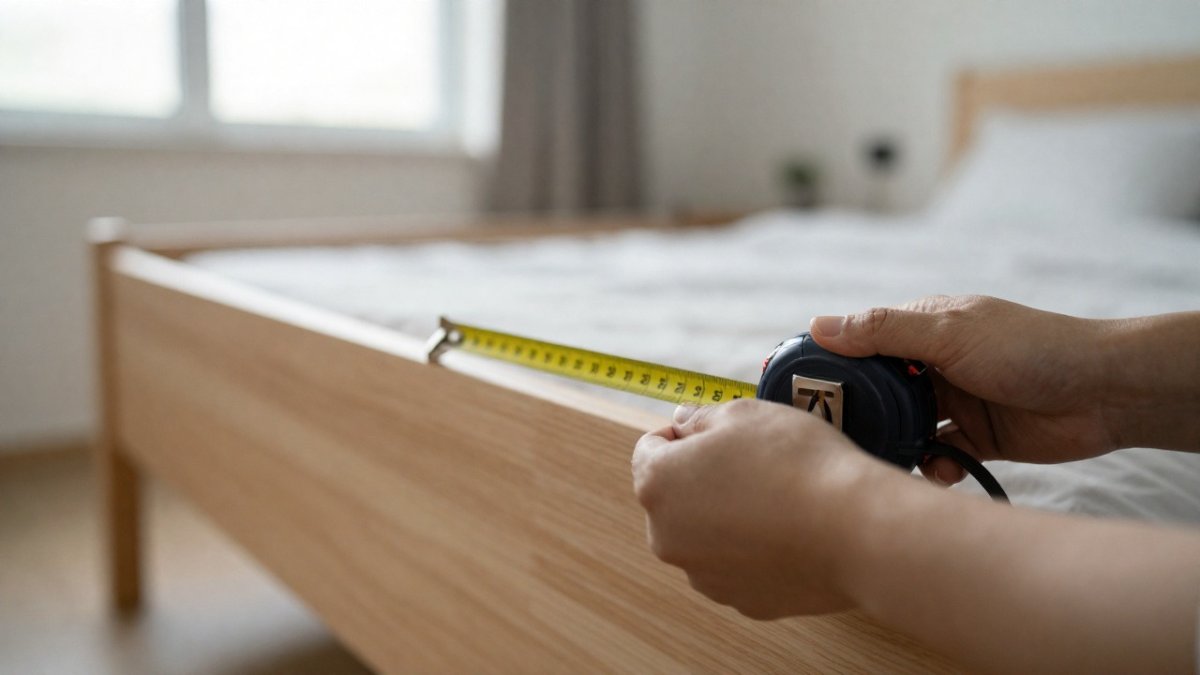
- Remove all bedding, pillows, mattress toppers and any loose slats or drawers that might shift during measuring.
- Clear space around the frame so the tape can lie flat from rail to rail and from headboard to footboard.
- Identify the frame type. A platform bed has a solid or slatted deck with a rail around the perimeter. A traditional frame pairs with a separate box spring that sits on the rails. An adjustable base is a motorized foundation that may have a different deck shape and a thinner profile.
- Measure the inner width and inner length of the sleeping surface, not the outer rail edges.
- Measure the outer footprint for floor-space planning, including headboard and footboard depth.
- Measure the height from the floor to the top of the side rails, then the rail height from the top of the rail to the deck.
- Measure the clearance under the frame, from the floor to the underside of the rail or deck, if you plan to use under-bed storage.
- Record each number with the frame type beside it before moving on.
For a platform bed, the inner dimensions are usually the cleanest to read, because the deck runs flush to the rails. For a traditional frame with a box spring, measure the inner rail opening, then confirm whether the box spring itself is the size you need, since many foundations are a few inches wider than the mattress they support. For an adjustable base, measure the deck in its flat position, because the surface can narrow or shift when raised, and check whether the base is designed for a standard mattress or a specific brand.
Clearance deserves its own check. Measure from the floor to the underside of the frame rail. A mattress plus foundation can raise your bed height by several inches, so confirm that the total height still lets you sit on the edge comfortably and that any under-bed bins or drawers fit the space you have.
A printable checklist can keep these measurements organized: frame type, inner width, inner length, outer width, outer length, rail height, deck depth, floor clearance and headboard height.
Watch out: Measuring only the outer rails on a platform bed will overstate the usable size, so always confirm the inner opening before you order a mattress.
Bed Frame vs Mattress Size Differences
A bed frame and a mattress can be listed as the same size but still differ by an inch or two. Frame sizes usually describe the outer footprint, while mattress sizes describe the mattress itself. The gap between them is where most fit problems start.
The safest rule is to match the inner frame measurement to the mattress size. To weigh your frame against your space and sleepers, read our guide to choosing the right mattress size. If your inner width is 60 inches and you are buying a queen, the fit should be snug but workable. If the inner width is much larger, the mattress may slide. If it is smaller, the mattress will not fit at all.
Measuring Bed Frame for Headboard Compatibility
Headboards and footboards affect the total length you need. Measure the headboard height from the floor to the top, and check whether it sits flush against the wall. A headboard that is too tall can make a bed look crowded in a small room.
Measure the distance from the top of the rail to the top of the headboard as well. This tells you how much height the mattress and bedding will add. Pillows and a comforter can change the look of the bed, so plan for a few extra inches above the mattress.
Measuring Antique, Non-Standard and Thick-Rail Frames
Older and custom frames break the assumptions that make modern measuring simple. A manufactured frame usually has a known rail profile, so the difference between the outer footprint and the usable inner opening is predictable. An antique or handmade frame may not follow that pattern, so the inner width has to be measured directly rather than calculated from the outer width.
Frame material changes the math. Solid wood rails are often thicker and may be joined with mortise-and-tenon joints or dowels that protrude slightly into the opening. Metal rails are usually thinner but may have welded brackets, center support legs or cross-slats that reduce the clear space at specific points. Upholstered or padded rails add another layer, since the fabric can compress under load and change the apparent inside edge.
To measure these frames accurately:
- Measure the outer width at the widest point of each side rail, then measure the inner width at the narrowest point where a mattress would actually sit. The difference is your effective rail allowance on each side.
- Check for protrusions such as bolt heads, corner blocks, slat supports and decorative trim. Note any that sit above the mattress deck height, because they can prevent a flush fit even when the width matches.
- Measure the depth of the mattress well, which is the rail height from the top of the side rail down to the slat or deck. Many antique frames have a shallower well than modern platforms, and a thick mattress can sit above the rails.
- Measure the diagonal of the inner opening. If the two diagonals differ by more than about half an inch, the frame is out of square and a standard mattress may bind at one corner.
- Photograph the frame from above with a tape laid across the inner opening, and keep the photo with your written numbers.
Watch out: Do not rely on the width printed on a label or a manufacturer’s listing for an older frame, because the listed size often refers to the original mattress, not the frame’s current opening.
If your frame’s inner opening falls between two standard sizes, or the diagonals show it is out of square, a standard size may not fit well.
Booking Your Mattress Fit Check With Mattress Outlet of Chattanooga
Once you have your measurements, you are ready to find the right mattress. Check our twin mattress options in Chattanooga, TN if you need a smaller size, or visit our mattress stores near you to see sizes in person.
To talk through your fit, call us today at (423) 255-8124.
Frequently Asked Questions
How can I tell what size my bed frame is?
Measure the inside width and length between the rails, where the mattress sits, rather than the outside edges. Standard frames match standard mattress sizes: twin is about 38 by 75 inches, full 54 by 75, queen 60 by 80, and king 76 by 80. If the measured inside dimensions fall close to one of these, the frame is almost certainly that size. Check the frame’s label or manufacturer documentation if one exists, since labels can differ slightly from measured dimensions.
Should I measure the inside or outside of the bed frame?
Measure the inside for mattress fit, because that is the space the mattress must occupy. Measure the outside when you need to know whether the frame fits in a room, through a doorway or against a wall. Many frames have outer dimensions several inches larger than the inner cavity because of rail thickness, so using the wrong measurement is a common cause of mattresses that do not fit. Record both numbers so you can make either decision later.
Is 52 inches a full-size bed?
A 52-inch width is not a standard full-size bed. Full mattresses are 54 inches wide, so a 52-inch inner frame is slightly narrow and will likely not accept a standard full mattress without gaps. Measure the inside width at the head and foot to confirm, since some frames are not perfectly square. If you have a 52-inch frame, look for a mattress made to that exact width or consider replacing the frame.
How much clearance do I need between my mattress and the frame?
A well-fitting mattress should sit snugly inside the frame with no more than about one inch of total play along the width and length. Excessive clearance lets the mattress shift and can damage the edges, while too little clearance makes it hard to lift and place. Check the mattress height as well, because a deep mattress on a low-rail frame may sit above the rails and affect how the headboard and footboard attach.


