
Best Mattress Brands for Longevity: What Actually Lasts
Table of Contents
- What Determines How Long a Mattress Actually Lasts
- Mattress Lifespan by Type: Construction Matters
- Durable Mattress Materials That Resist Sagging and Wear
- Mattress Warranty and Durability: What Coverage Really Means
- How to Extend Your Mattress Lifespan: Maintenance and Care
- Durability by Sleeper Profile: Who Gets the Most Years
- Total Cost of Ownership: Price Versus Years of Use
- Frequently Asked Questions
Last Updated: October 8, 2026
What Determines How Long a Mattress Actually Lasts
A mattress’s lifespan depends on three factors: construction type, material quality, and maintenance. The best mattress brands for longevity invest in high-density foams, heavy-duty coil systems, and durable covers that resist wear and sagging.
Construction quality matters most. A mattress with reinforced edge support, individually wrapped coils, and premium foam layers outlasts a budget model with thin materials.
Maintenance habits extend lifespan significantly. Rotating every three months, using a quality foundation, and protecting against moisture all help. A well-maintained mattress can outlast a neglected one that started with better construction.
Mattress Lifespan by Type: Construction Matters
Construction type determines whether you’re investing in a seven-year mattress or a twelve-year one.
Innerspring and Coil Mattresses
Innerspring mattresses typically last 5-7 years. The coil system is the core support structure, and its gauge (thickness) directly affects durability: heavier-gauge coils resist compression better.
Coil quality matters more than count. A mattress with 400 heavy-duty coils often outlasts one with 600 thin coils.
Padding layers wear faster than coils. Budget innersprings use thin foam or polyester batting that compresses quickly; premium models add memory foam or latex that holds up longer, extending life to 7-8 years.
Memory Foam and Polyurethane Mattresses
All-foam mattresses typically last 6-8 years. Foam density is the key durability metric: higher-density foam resists impressions and sagging better.
Memory foam loses its ability to spring back over time, at a rate set by density and weight load. A 5-pound-per-cubic-foot foam sags noticeably within five years; a 7-8 pound density maintains support longer.
Polyurethane foam, common in budget mattresses, lasts only 4-5 years and compresses under sustained pressure. Premium all-foam models use multiple layers of varying densities to distribute weight and reduce compression in any single layer.
Hybrid Mattress Performance
Hybrid mattresses combine coil support with foam comfort layers, often delivering 7-9 years. The coil base provides structural integrity while foam adds pressure relief and motion isolation.
Hybrids outlast all-foam mattresses because the coil system prevents uniform sagging: when foam compresses, the coils still provide foundational support. That’s why many of the most durable mattress brands use hybrid construction.
Hybrids are heavier and pricier than pure foam, but if longevity is the priority, the structure justifies the investment.
Latex Mattresses
Natural and synthetic latex mattresses often last 8-10 years or longer. Latex resists compression and maintains its shape through years of use.
Latex durability comes from its molecular structure: unlike polyurethane foam, which breaks down as cells collapse, latex maintains elasticity under extended pressure.
Latex costs significantly more upfront, but the extended lifespan means a lower cost per year of use.
Durable Mattress Materials That Resist Sagging and Wear
The materials inside your mattress determine how well it resists impressions and sagging.
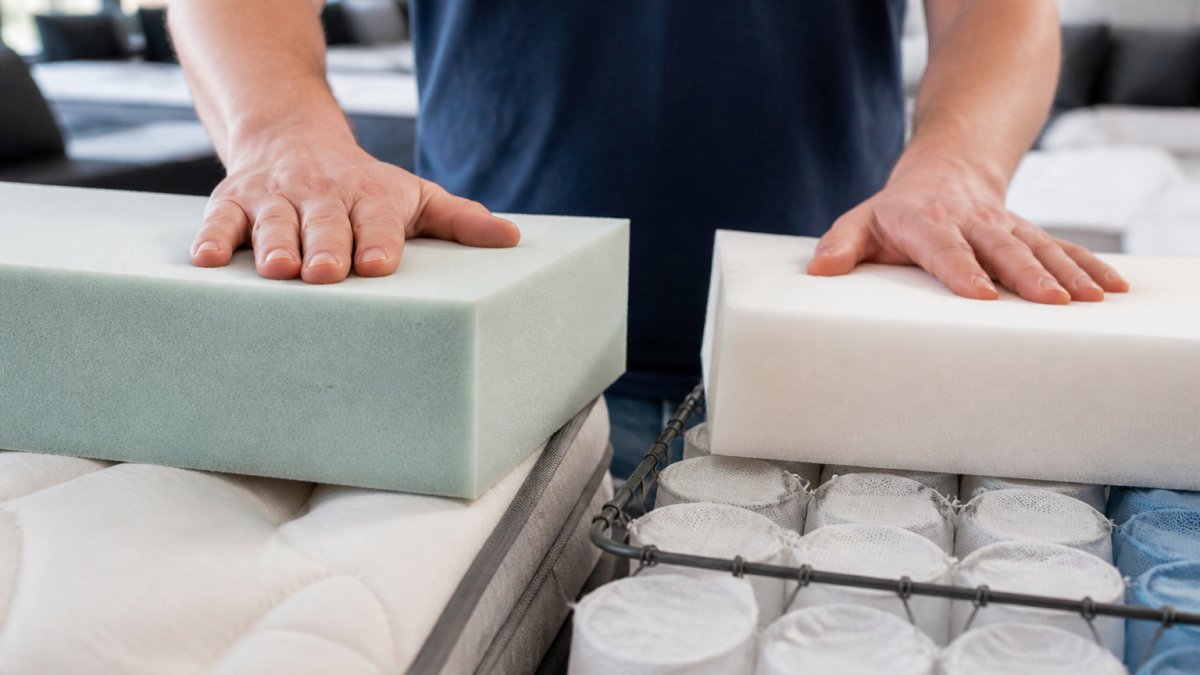
Foam density is measured in pounds per cubic foot.
Coil gauge and type matter for innerspring and hybrid models. Lower gauge numbers mean thicker wire (14-gauge is heavier-duty than 16-gauge).
Cover materials matter too. Quality polyester or cotton blends resist pilling and tearing better than cheap fabrics, and reinforced edges prevent separation over years of use.
Edge support reinforcement is often overlooked but critical.
The specs that actually predict longevity
A brand’s durability story lives in its published specifications. When a manufacturer discloses these numbers, you can compare models directly instead of trusting adjectives:
- Core foam density. Look for support-core polyurethane foam at 1.8 lb/ft³ or higher, and memory foam comfort layers at 4 lb/ft³ or higher. Foam below roughly 1.5 lb/ft³ in a support layer is the single most common cause of early body impressions.
- Coil gauge and count. Innerspring and hybrid cores commonly use 13-15 gauge wire; lower gauge numbers mean thicker wire and better resistance to compression. Coil counts in the 700-1,000 range (queen) are typical for premium hybrids, but gauge and coil design matter more than raw count.
- Edge support type. Foam-encased or coil-based perimeter reinforcement holds its shape far longer than a mattress with no dedicated edge system.
- Cover and fire-barrier construction. Tightly woven covers and quilted (rather than glued) fire barriers resist delamination and pilling over time.
Why brand reputation alone is a weak signal
A well-known brand can sell both a 10-year hybrid and a 4-year budget foam under the same logo. Longevity is a property of the model and its materials, not the label. Evaluate published specs, warranty language, and multi-year owner reports together, and treat “lasting decades” claims without supporting specs as marketing, not evidence.
Mattress Warranty and Durability: What Coverage Really Means
A warranty is a legal promise about defects, not a prediction of comfort lifespan. Pairing that distinction with a cost-per-year calculation is the most reliable way to judge long-term value.
What a warranty does and does not cover
Most mattress warranties cover manufacturing defects: broken coils, sagging beyond a stated threshold, and cover or seam defects. They typically do not cover:
- Normal softening or body impressions below the stated sag threshold (commonly 1.5 to 2 inches)
- Damage from an unsupportive foundation or improper bed frame
- Stains, which usually void coverage entirely
- Comfort preference changes
That’s why a 10-year warranty doesn’t mean a 10-year mattress, it means replacement if the mattress fails in a specific, defined way within that window.
Warranty terms worth comparing
- Sag threshold. A warranty that covers impressions over 2 inch is stronger than one that requires 2.5 inches.
- Proration. Some warranties are fully covered for the first several years and then prorated, meaning you pay a percentage of the replacement cost as the mattress ages.
- Transferability. A transferable warranty can add resale or hand-me-down value.
- Proof of purchase and foundation requirements. Most brands require the mattress to be used on an approved foundation; using the wrong base can void coverage.
Total cost of ownership: the number that matters
Warranty length is a weak proxy for value. The stronger metric is cost per year of expected use: divide the purchase price by the years you realistically expect the mattress to stay supportive.
- A $500 mattress that stays comfortable for 5 years costs about $100 per year.
- A $1,000 mattress that stays comfortable for 8 years costs about $125 per year.
- A $1,500 mattress that stays comfortable for 12 years costs about $125 per year.
The cheapest mattress isn’t automatically the best value, nor the most expensive the worst. The math rewards models that hold support long relative to price, so run this calculation on both before deciding.
Where warranties fit into the calculation
Treat the warranty as a safety net, not a lifespan guarantee. It reduces your downside if the mattress fails early but doesn’t extend comfort life. The factors that do are the ones you control: a supportive foundation, a waterproof protector, regular rotation, and materials matched to your body weight and sleeping position.
How to Extend Your Mattress Lifespan: Maintenance and Care
Simple maintenance can add 2-3 years to your mattress’s life.
Rotate every three months. Rotation distributes wear evenly; without it, the same areas compress repeatedly, creating permanent impressions.
Use a quality foundation. A worn box spring or weak frame forces the mattress to sag in the middle.
Protect from moisture. Moisture accelerates foam breakdown and mold growth.
Clean the surface regularly. Dust and debris break down fabrics over time. Vacuum monthly and spot-clean stains promptly.
Durability by Sleeper Profile: Who Gets the Most Years
Lifespan varies by body weight, sleeping position, and number of users.
Side sleepers concentrate pressure on shoulders and hips, creating localized compression; back sleepers distribute weight more evenly; stomach sleepers pressure the lower back and hips.
Couples wear mattresses faster than single sleepers: two people create more total pressure, and one partner’s movement stresses the structure.
Hot sleepers who sweat heavily should invest in moisture-resistant covers and cooling gel foams. Excess moisture accelerates breakdown of standard foam materials.
Total Cost of Ownership: Price Versus Years of Use
The cheapest mattress isn’t always the most economical once you factor in lifespan.
Consider your timeline: if you move frequently or plan to replace the mattress in five years, a budget model makes sense.
Mattress Outlet of Chattanooga helps customers find durable options at significant savings. By sourcing quality mattresses through smart truckload pricing, we offer brand-new mattresses at 60-80% below retail prices.
Calculate total cost of ownership by dividing mattress price by expected lifespan. A $600 mattress lasting seven years costs about $86 per year.
Finding the best mattress brands for longevity means prioritizing construction quality, material durability, and proper maintenance over initial price. When you’re ready to invest in a mattress built to last, Mattress Outlet of Chattanooga offers durable, brand-new options with flexible payment plans and significant savings.
Frequently Asked Questions
What type of mattress is best for longevity?
Latex and high-quality hybrid mattresses typically last longest, often 8-10+ years. Latex resists sagging better than foam; hybrids combine durable coil support with foam comfort. Innerspring mattresses with heavy-duty coils and high coil gauge (lower numbers = thicker wire) also perform well. Memory foam alone tends to compress faster, usually lasting 6-8 years. Your mattress lifespan depends on construction quality, foam density (5+ pounds per cubic foot is durable), and how well you maintain it through rotation and proper support.
How long should a good mattress last?
A quality mattress should last 7-10 years with proper care. Budget mattresses may show sagging or body impressions within 5-6 years. Premium construction—thick coil gauges, high-density foam, and durable materials—extends lifespan to 10+ years. Factors affecting durability include body weight, sleeping position, mattress rotation frequency, and foundation support. A mattress warranty often reflects expected lifespan; longer coverage (10-15 years) signals manufacturer confidence in durability.
Do latex mattresses last longer than memory foam mattresses?
Yes, latex mattresses typically outlast memory foam. Natural or synthetic latex resists body impressions and sagging better, often lasting 8-10+ years. Memory foam compresses over time and usually lasts 6-8 years, though high-density foam (5+ pounds per cubic foot) performs better than lower-density versions. Latex’s resilience means it bounces back after pressure, while foam gradually loses support. For maximum longevity, choose latex or hybrid designs with substantial coil support and high-density foam layers.
What mattress materials are most durable?
Natural latex, high-coil-gauge innerspring systems, and high-density polyurethane foam resist wear best. Latex offers superior resilience and resists sagging; coils with lower gauge numbers (thicker wire) provide lasting support; high-density foam (5+ pounds per cubic foot) maintains shape longer than low-density alternatives. Hybrid mattresses combining these materials extend lifespan significantly. Avoid low-density foam (under 3 pounds per cubic foot) and thin coil systems, which deteriorate faster. Quality edge support also prevents premature sagging at mattress borders.
